
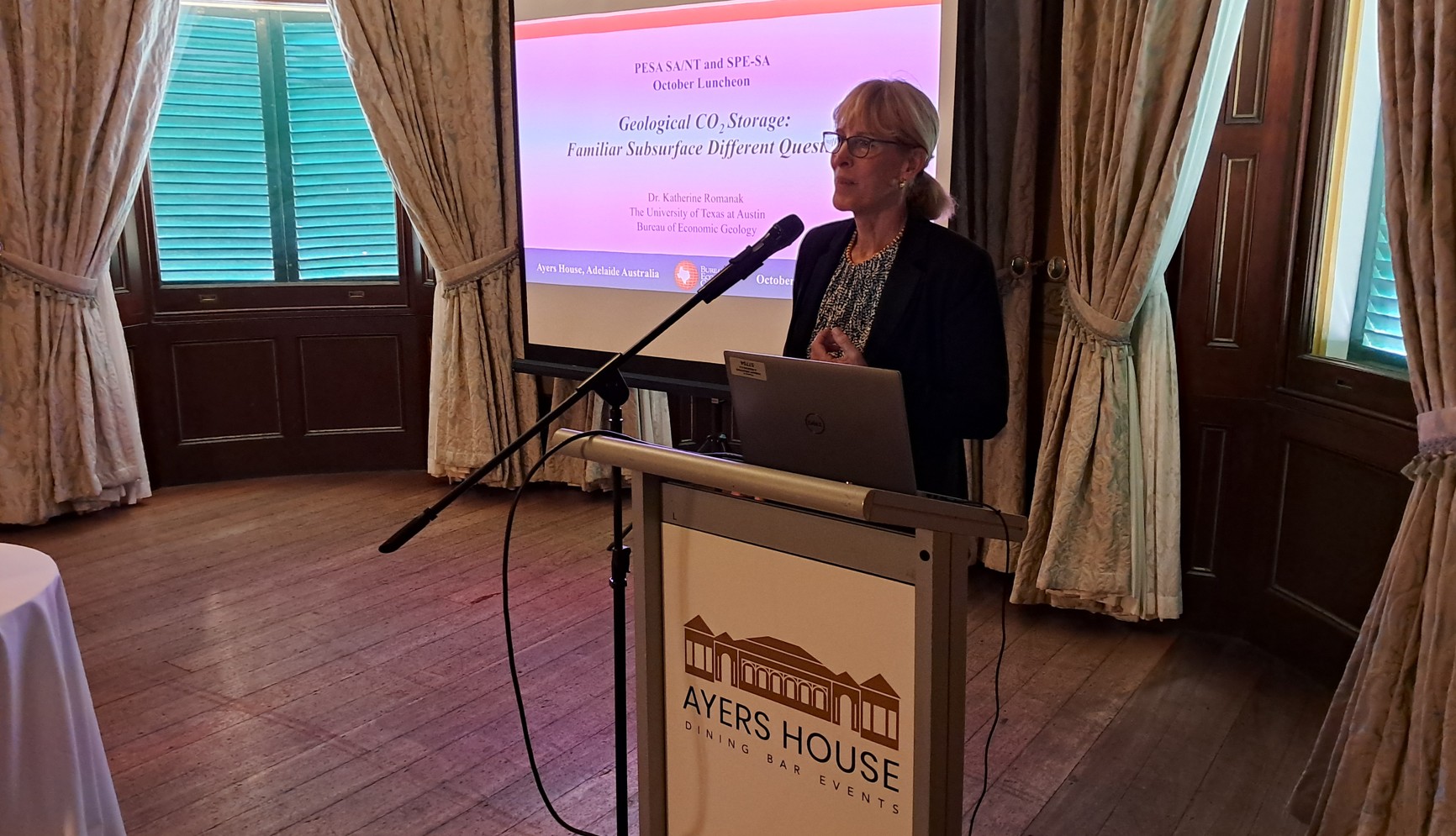
PESA SA-NT Luncheon Report by Andrew McPhail
Combined PESA SA/NT and SPE-SA luncheon on Thursday 22 October 2026.

Katherine is a Research Professor at the of The University of Texas at Austin’s Bureau of Economic Geology and an internationally recognised expert in monitoring and assurance for geological CO₂ storage. Her unusual path into the field began as an igneous petrologist and volcanologist with the Smithsonian, reporting on volcanic activity in real time, before moving into environmental monitoring, including nitrogen cycling in perched wetlands. After ten years at home raising her family, she returned to geology with the Bureau of Economic Geology, focusing on environmental monitoring at CCS sites. Since 2007 she has developed monitoring approaches for more than six large-scale injection projects, with field studies in the United States, Australia, Japan and Canada. She credited much of her success to being willing to ask different questions.
Katherine framed her talk around three key questions that regulators, operators and the public commonly ask:
- Is CO2 injection simply production in reverse?
- Does unexpected migration of CO2 mean containment has failed?
- Does leakage cause environmental harm?
Her central argument was that before deciding what to monitor, you must be clear about the question the monitoring is meant to answer. She distinguished three objectives that are often unintentionally conflated: demonstrating containment, protecting the environment, and accounting for emissions. The definition of leakage is easily misinterpreted and sometimes sensationalised. Unexpected subsurface behaviour of CO2 has been interpreted from monitoring schemes which now inform our understanding and does not mean projects have failed.
In the deep subsurface, injected CO2 displaces brine and generates a pressure front that propagates beyond the CO2 plume itself. The main risk is pathways from the legacy wells and faults. Katherine’s point was that monitoring has proven effective at detecting these issues, and that what has been learned from it has been used to improve storage systems and provide the basis for regulations. CO2 injection is not just production in reverse.
Katherine drew on experiments and CO2 leakage from field injection. The ZERT project was cited as an example, where CO2 was deliberately released in the shallow surface to test detection and measure impacts.

A key leakage and environmental concern is that CO2 could act as a catalyst for mobilising metals into aquifer water. Experiments have not shown this to be significant, and aquifers tend to self-remediate over time. In onshore settings the effects of CO2 in the biosphere are spatially limited, as plants and microbes take up significant amounts of CO2. In marine environments bubble plumes dissolve within about 10 m of the sea floor. Overall impact to these environments is localised and largely insignificant.
Distinguishing leakage from natural CO2 depends on comparing baseline data with observations. Katherine has patented a process-based method that uses gas ratios to distinguish CO2 derived from naturally process from leakage and migration from an injection well.
Katherine responded to numerous questions with one around public education and communication. In her view getting the right message out to the public depends on transparent monitoring, education, and building trust through relationships on the ground.
For an Australian audience with growing CCS activity, the talk was a strong reminder that the science on leakage impacts is reassuringly low, but that the industry’s challenge is building a trustworthy dialogue with stakeholders on monitoring and measurement.

Related Articles

20/07/2021

08/09/2026