A life lived without regrets, and such enormous fun
Geological Survey of Western Australia
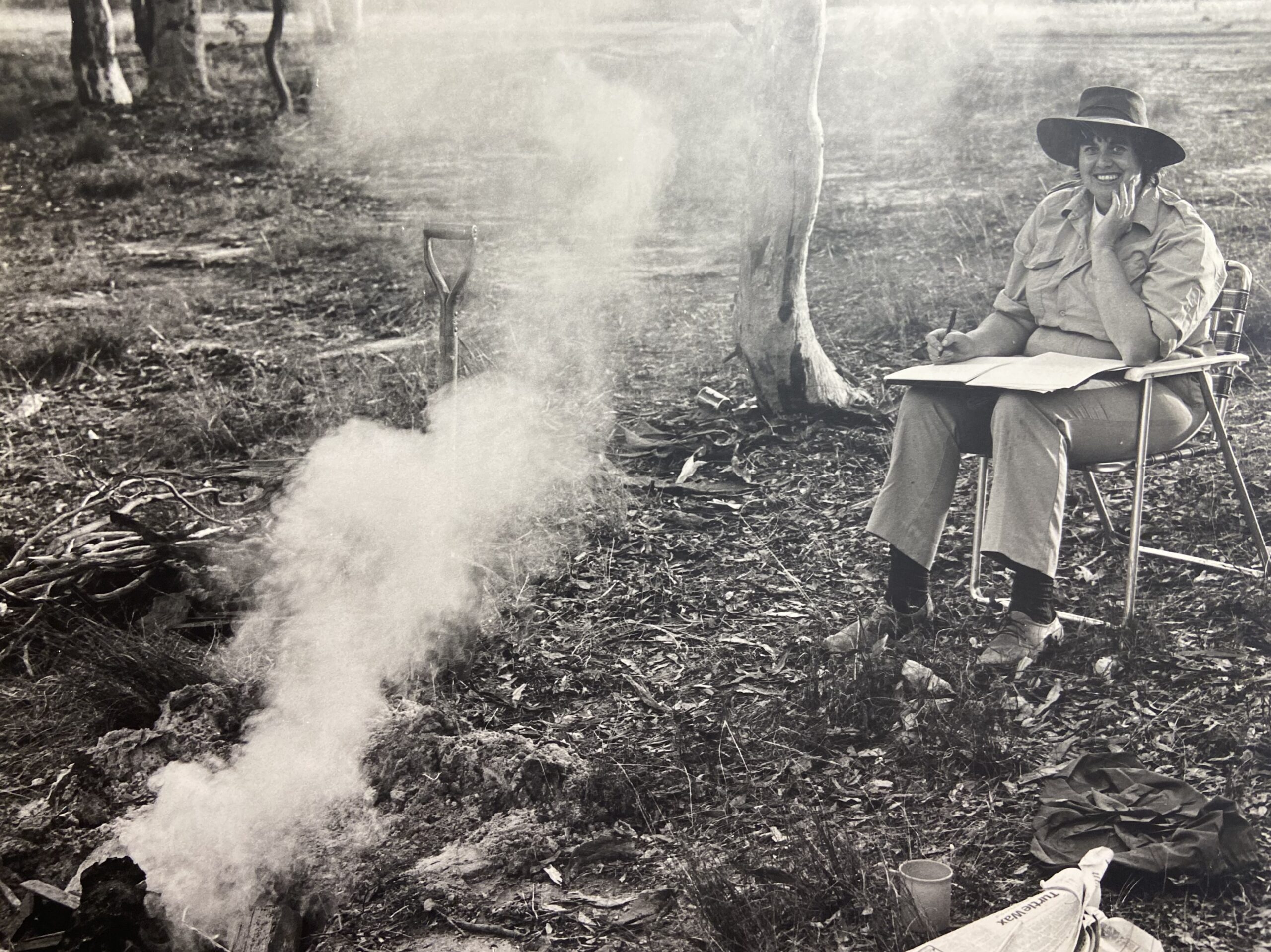
Image above: Kath camping at the North Pole Dome, Pilbara region, Western Australia, in the 1970s. Supplied Stephanie Rusyn.
Dr Kathleen ‘Kath’ Grey was a palaeontologist, geologist, field scientist and former Chief Palaeontologist at the Geological Survey of Western Australia (GSWA), whose five plus decades of geological and palaeontological research have transformed our understanding of some of Australia’s oldest evidence of life. Kath combined meticulous observation, an instinct for following elusive clues, and extraordinary enthusiasm to investigate fossils spanning 3.5 billion years of Earth history. Her work on microbialites (especially stromatolites) and microfossils, from across the State of Western Australia and beyond, established her as an internationally recognised authority in Precambrian palaeontology and stratigraphy. Kath navigated the challenges of remote fieldwork, professional setbacks and the barriers faced by women in a largely male-dominated profession with grit, and met misadventure and adversity with characteristic humour. This positive outlook, combined with her famed hospitality and enthusiasm for sharing knowledge, endeared her to countless geoscientists both in Australia and internationally.
Born in Blackpool, England, in 1946, Kath’s fascination with the natural world was apparent from a young age. While her classmates collected flowers and seashells, Kath collected rocks, and she recalled being regarded as somewhat odd by children her own age, preferring David Attenborough to the Beatles and Elvis Presley. She later credited her father, a Blackpool police detective, with instilling in her the forensic approach to science that would later become a hallmark of her geological work. Holidays in the Scottish Highlands nurtured her love of geology and remote landscapes, while Scouting gave her practical skills that would later prove invaluable during fieldwork in the Australian bush.
In 1966, Kath entered Sheffield University to study geology, with a characteristically eventful introduction to university life. During her first week, she reactivated a pre-existing back injury in a mishap involving a bus and a newly purchased geological hammer. As a result, Kath spent much of her first term as a university student in hospital suspended in traction. In a bid to continue her studies, Kath read a copy of Holmes’ (reportedly 10 inches thick!) Principles of Physical Geology ‘cover to cover’ thanks to a mirror installed over her hospital bed. This ingenious approach not only allowed her to continue studying, but meant that she became proficient in the art of reading text backwards!
Kath graduated from Sheffield in 1969 and, despite disruption to her undergraduate mapping project by an outbreak of foot and mouth disease in the field area, went on to complete a Master’s degree in palynology studying Early Carboniferous miospores from the Scottish borderlands. This training in the identification, morphology and stratigraphic interpretation of organic-walled microfossils provided a strong foundation for the biostratigraphic work that would become a central part of her career. In 1971, Kath accepted an editing position within GSWA, moving to Perth as part of a cohort of international geologists employed to fill staffing gaps caused by local geologists leaving for resource industry careers during the late 1960s ‘nickel boom’. She soon moved from editing to the palaeontology section, thereby beginning a long and influential career in Western Australian geology.
In the early 1970s, opportunities in field geology were limited for women. At GSWA, Kath was initially told that fieldwork north of the 26th parallel was too ‘wild and woolly’ and she was required to study fossils collected by her male colleagues instead. Kath would later recall the absurdity of this restriction with humour, but it reflected the very real institutional barriers encountered early in her career. Despite this, the strong social bonds formed with her colleagues and the exciting mapping work being undertaken across the state proved an irresistible lure that overtook Kath’s original plans to return to the UK after a few years’ experience in Australia. Her early project work at GSWA included studies on Devonian and Carboniferous palynology and Devonian brachiopods, primarily from the Canning Basin. Finally in 1975, in the absence of any volunteers from the palaeontology section, Kath was asked to investigate stromatolites in the Mesoproterozoic Bangemall Basin (now the Edmund and Collier Basins), although she later admitted she had to look up what a stromatolite was before setting out! The resulting six-week expedition was, in true Kath fashion, memorable for all the wrong reasons. Kath had to overcome an intractable, dishonest and drunken field assistant, bogged and broken vehicles, and approximately 30 flat tyres, but did so with her characteristic determination. This experience not only cemented her enthusiasm for field geology but ultimately introduced her to the subject that would define much of her scientific career.
Kath soon became fascinated by stromatolites, layered structures produced through the interaction of microbial communities and their environment. She undertook extensive field investigations, eventually documenting stromatolites from more than 1000 localities based on her own fieldwork and the specimens brought to her by colleagues, representing a remarkable proportion of the State’s geological record. This, together with her detailed studies of Precambrian organic-walled microfossils, provided the basis for interpreting the age, environment and correlation of numerous ancient sedimentary successions.
After two decades at GSWA, Kath took study leave to join a research group at Macquarie University investigating the newly recognised Ediacaran Period. There she completed a PhD focused on organic-walled microfossils from Australian late Neoproterozoic successions, graduating in 1998. Her substantial monograph on the Ediacaran palynology of Australia, published as a Memoir of the Australasian Palaeontologists, documented the systematics and distribution of approximately 60 new fossil species and provided a biostratigraphic framework with applications well beyond individual geological basins.
On returning to GSWA, Kath continued her stromatolite (and other microbialite) and microfossil research with characteristic fervour. Her work was closely integrated with GSWA’s regional mapping program, contributing to the interpretation, correlation and age of sedimentary successions across Western Australia, and finding applications for this knowledge in the resources industry. Over the course of her career, Kath published more than 100 scientific papers, produced more than 200 geological reports and was responsible for the description and naming of more than 100 new taxa. Counted among the many scientific achievements are her contribution to the award-winning book The Rise of Animals: Evolution and Diversification of the Kingdom Animalia published in 2008; work on the enigmatic ‘chain of beds’ fossils; and the study of stromatolites from the Strelley Pool Formation, including the recovery of an iconic slab of ‘egg-carton’ stromatolites now on display in WA Museum Boola Bardip. Her proudest achievement was the publication in 2020 of the Handbook for the Study and Description of Microbialites, cowritten with friend and long-time collaborator Prof. Stanley Awramik, which brought together decades of accumulated knowledge and experience studying these still-underappreciated fossils. Kath continued her research after formally retiring from GSWA in 2013, maintaining collaborations with colleagues and contributing to projects both in Australia and internationally.
Outside of her scientific research, Kath was deeply committed to site conservation and geoheritage, spearheading GSWA’s effort to conserve a set of key early life sites as State Geoheritage Reserves, and involving herself in efforts to protect living microbialite localities such as Lakes Clifton and Thetis. She was also aware of the importance of geotourism and geological education opportunities for those outside the geological profession, and championed the application of paleontological studies to exoplanetary exploration and astrobiology. Finally, Kath devoted much of her later career to mentoring students and early-career researchers, both local and international, and regularly invited visiting researchers to stay with her. Her home became an informal extension of the laboratory and field camp: a place where visiting researchers could stay, ideas could be discussed late into the evening, and Kath could share her extraordinary knowledge of Precambrian palaeontology, often accompanied by a good meal and a story or two. She was known to be particularly fond of children; many of her colleagues’ children grew up in her garden listening to chatter about rocks and fossils, and were gifted bookshelves of science books by Kath for Christmases and birthdays.
Kath faced her final formidable challenge in 2018 when diagnosed with the advanced stages of oesophageal cancer. True to form, she approached the diagnosis pragmatically, carefully considering her options before deciding to ‘give her body up to science’ by participating in a clinical trial. She embraced the trial with characteristic curiosity, taking a keen interest in the science behind her treatment and enjoying discussions with the doctors and researchers involved. The treatment proved successful in extending her life well beyond her initial prognosis, allowing her to continue her scientific work for years more. Despite the initial success, complications of her treatment saw an eventual decline in her health. Kath died peacefully in August 2026, with her final days spent in the company of many of her former GSWA colleagues, past classmates and friends she had made during her life in Perth.
The significance of Kath’s scientific contributions and her service to the Australian geoscience community has been recognised through numerous awards, most notably the Gibb Maitland Medal awarded by the Geological Society of Australia’s Western Australian Division in 2003, and the Robert Etheridge Jr Medal for Lifetime Achievement in Australasian Palaeontology awarded by GSA Special Interest Group Australasian Palaeontologists in 2019. In accepting the Robert Etheridge Jr award, Kath reflected on the enormity of her career and legacy, concluding: ‘Perhaps my biggest achievement is to be able to say that I have very few regrets and that my life has been such enormous fun.’ A parting wish to be scattered on some nice stromatolite outcrop here in Western Australia will come as no surprise to anyone who knew her. With this final act, Kath will remain exactly where she has always belonged, in the field among the rocks she spent a lifetime exploring, reminding us to look a little closer.
Vale Dr Kathleen Grey