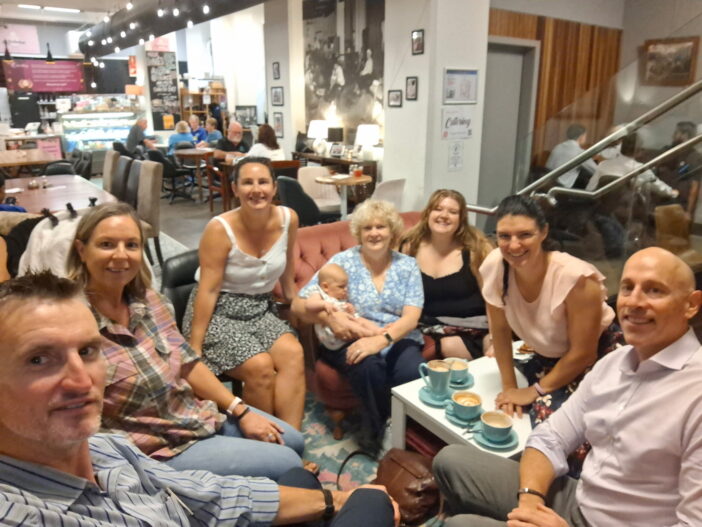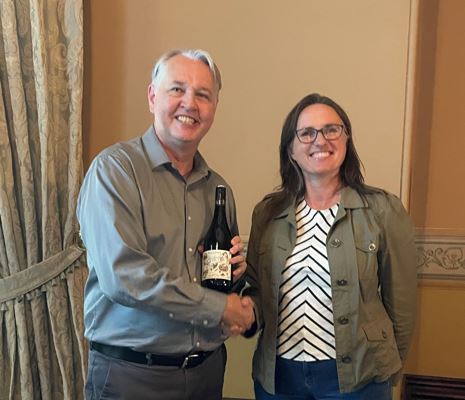
PESA VIC/TAS branch is actively working on its schedule of meetings and will bring some in-house events to the membership ASAP. Meanwhile, some of the branch membership are able to access meetings of our sister geoscience societies in Melbourne. On Friday 10th October, a few PESA Victorians attended the SPE lunchtime talk given by the SPE Distinguished Lecturer Mike Byrne, of Elemental Energies. Mike spoke on the topic of CO2 injection well design with the subtitle "The same, but different".
PESA Gazette


Notice of Membership Fee Increase
The PESA board advises that there will be a small membership fee increase, effective from December 2025. The fee increase of approximately 2.5% will account for CPI increase and will ensure that PESA can continue to provide members with a range of high value services. Small fee increases, consistent with inflation, ensure that larger more impactful fee increases are not required in the future.
The fees below will apply to both new and renewing members.
Please note that there are no changes to Retired or Graduate membership fees, and Student membership will continue to be free.

Australian Natural Hydrogen Conference 2025
It’s a crucial year for the potential commercialisation of natural hydrogen, and the second Australian Natural Hydrogen Conference October 21-23 in the Adelaide Hills promises to shed new light on this emerging energy source.
With a handful of companies worldwide having confirmed high levels of natural hydrogen in the ground, all are now racing to prove they can commercialise the zero-carbon resource, and the conference, put on by the Natural Hydrogen Association of Australia, has some of the industry’s heavyweights fronting attendees.
Since the inaugural Natural Hydrogen Association of Australia conference in 2024, the game has changed.

Carbon Loop #13
Read the full newsletter here
Hello and welcome to The Carbon Loop — a newsletter by the CCUSNA dedicated to highlighting the Australian carbon capture, utilisation and storage industry
The Federal Government has dropped a suite of Net Zero strategies covering key parts of the economy: transport, resources, industry, built environment, agriculture and land, and electricity. Together with the overarching Net Zero Plan, these reports provide the most detailed picture yet of how Australia expects to meet its emissions commitments.
There’s a bajillion pages to get through and I’m a long way from having an informed opinion, but my initial hot take is a bit: Hmm.. really?

WA Basin’s workshop to be held 1st-2nd Dec at Curtin University
The 2025 Basins Workshop will take place on Monday 1 and Tuesday 2 December 2025 at Curtin University, Perth in association with PESA WA Branch. The aim of the workshop is to provide an informal forum for the exchange of insights and ideas regarding the evolution of sedimentary basins in Australia and around the world, and the diverse resources they contain, including hydrocarbons, minerals, geothermal energy, natural hydrogen, and the potential for CO2 and hydrogen storage.
Talks are limited to 10 minutes in duration, with ample time for discussion, so we are looking for thought provoking ideas, rather than polished conference presentations.

OPINION PIECE – Climate Change and the Demise of PESA – By Dennis Morton
By Dennis Morton - Member NSW branch https://www.linkedin.com/in/dennis-morton-a7587121/
Australia’s petroleum exploration and production industry has been in decline for decades and professional societies like PESA-Australia are suffering. Membership is falling, meeting and conference attendance is low and branch budgets are under pressure. Without significant change branches in Victoria and NSW may fold. The ACT branch merged with NSW after Geoscience Australia discouraged employee involvement, citing federal government policies that demonise fossil fuels.
Academia has also been affected with most Earth Science faculties in Australian universities closing.

PESA QLD Welcome Dr Brian Willis
PESA Queensland were thrilled to host Dr Brian Willis for an evening lecture on his whistle-stop tour of the Australian states and territories.
Dr Willis is a recognised expert on fluvial systems, with more than four decades spent studying the sedimentology and stratigraphic organisation of these depositional systems. This time, his focus was on the terminal end of the system with three-dimensional architecture of wave-dominated delta deposits the topic of the presentation.
Dr Willis, and his co-authors Tao Sun and Bruce Ainsworth, are using numerical models to challenge long-held rational for interpreting sea level variations in wave-dominated shallow-marine successions.

MGPalaeo Honour Australia’s most famous Palynologists with Artwork at New Lab
MGPalaeo are excited to announce their fully rebuilt laboratory offering significantly more space for an expanding suite of services. They have also taken the opportunity to decorate the place with a mural including selected palynomorphs honouring some of Australia’s most famous palynologists. Read on to learn more about their motivation and the palynologists their artwork honoured.
Time for a rebuild
The original lab was built in 2012 after relocating the main office from Maitland (South Australia) to Perth (Western Australia).

New PESA Webinar Library and Pete’s Webinar Picks
Peter Hoiles – PESA Webinar Coordinator
PESA Webinar Library
It is hard to believe that we have nearly five years under the PESA Webinar Series belt. Over this time, we have heard from many speakers on a number of topics of interest to PESA members, from oil and gas exploration in Australia and from across the World, to visiting several facets of the “Energy Trilemma”. Many of these speakers have graciously given their permission for their video recordings to be made available to PESA members for viewing at their leisure.

WA evening talk – US Double act on fluvial systems
A good crowd again assembled for Perth PESA evening talk on August 14, a double act on fluvial systems by John Holbrook (Texas Christian University) on the “Back-water Effect” on fluvial systems and Steve Hasiotis (University of Kansas) on the Neoichnology of the De Grey ephemeral river delta, Northwest WA
John Holbrook’s talk on the backwater effect provided an interesting discussion on fluvial architecture styles and an emerging tool and a work flow for predicting reservoir architecture, dimensions, volumes and heterogeneity in fluvial systems.
Steve Hasiotis described the diagnostic patterns of plant and animal traces (and diversity),...