
Geology guide: Andrew McKerron
Attendees: Paul and Anne Strong, Alex Ross, Isabella Miranda, Eva-Maria Rumpfhuber, Kym Dixon, Sharon Tiainen, Chris Cubitt, John Kaldi and Markus Häring

Alex Ross invited us to the excursion with the words: “Each day is a small lifetime. Live a good life today.” To say it upfront: we lived up to it.
The aim of the excursion was to explore how much the geological foundation influences the quality of the wine produced. There are countless variables behind a good wine, starting with the grape variety, the climate and the winemaking – and then, of course, the soil. Soil formation is influenced not only by the underlying geology but also by climate, which affects its thermal properties, chemistry, texture and drainage.
The question of how geology influences wine quality clearly leaves a lot of room for discussion – and that is a good thing. At six stops, we explored the question under the expert guidance of Andrew McKerron.
Stop 1: d’Arenberg – An introduction to the local geology
I joined the party, travelling in a tour bus – what else in a cellar-door region – at the iconic d’Arenberg winery. We did not discuss its avant-garde art or its wines, but went straight to the geological setting of the Willunga Embayment.
Standing on the youngest sediments of our excursion, the Pleistocene Pirramimma Sandstone, Andrew introduced us to the structure of the Willunga Embayment. It is a half-graben, bounded by the Willunga Fault to the south-east and the Clarendon – Ochre Cove Fault to the north-west. The half-graben formed in the Eocene, associated with the final separation of Australia and Antarctica.
Stop 2: Maxwell Wines – wine tasting and geology
Maxwell’s wines grow on the Blanche Point Formation, porous calcareous marls of Eocene age. We then had the chance to taste some excellent products, with expert explanations on site: sparkling mead, Picpoul, Fiano, Tears of Wisdom Grenache and the Eocene “Ancient Earth” Shiraz.
A fun fact: Lewis Maxwell, son of company founder Mark Maxwell, is a geologist and one of the driving forces behind the geological information boards around the wine region.
Unfortunately, we didn’t get to sample any of the fare from Maxwell’s Michelin Star-awarded restaurant.
Stop 3: Kay Brothers – no wine tasting, geology only
The South Maslin Sands are sediments from a late Eocene marine transgression over the North Maslin Sand and the Permian rocks of the Willunga Embayment. These glauconitic sands provide minerals and nutrients for the soil, which vine roots apparently can penetrate easily.
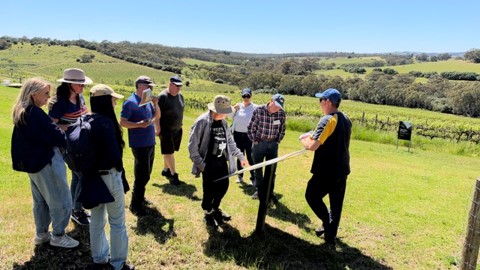
Stop 4: Paxton Wines – no wine tasting, geology only
Paxton wines are grown on the Reynella Siltstone Member of the Elatina Formation. This unit is about 650 million years old and occurs beneath the Willunga Embayment. The sediments were deposited during the Marinoan glaciation. They are the oldest rocks we visited.
Stop 5: Maslin Beach – no nude swimming, geology only
At the bottom of the stairs down to the beach, the Eocene South Maslin Sands and North Maslin Sands lie unconformably above the Permian rocks. Their greenish colour comes from glauconite, a mineral typical of shallow-marine sands. Time was spent looking for fossils.
Stop 6: Victory Hotel – a fitting finale
No geology here – just great food, great wine and great company at the iconic Victory Hotel.
One remarkable comment during the excursion – though I cannot remember who said it –was: “Grapes are weeds. They grow anywhere.” This brings me back to the fact that there are definitely more factors involved than the geological substrate. Fortunately, that leaves the topic open for discussion on future excursions to the region.
Our thanks go to Andrew McKerron for his excellent guidance, Alex Ross for the logistics, the tour operator for the safe driving and, last but not least, the chefs at the iconic Victory Hotel for the outstanding sirloin steaks.