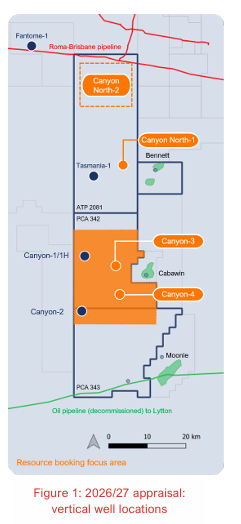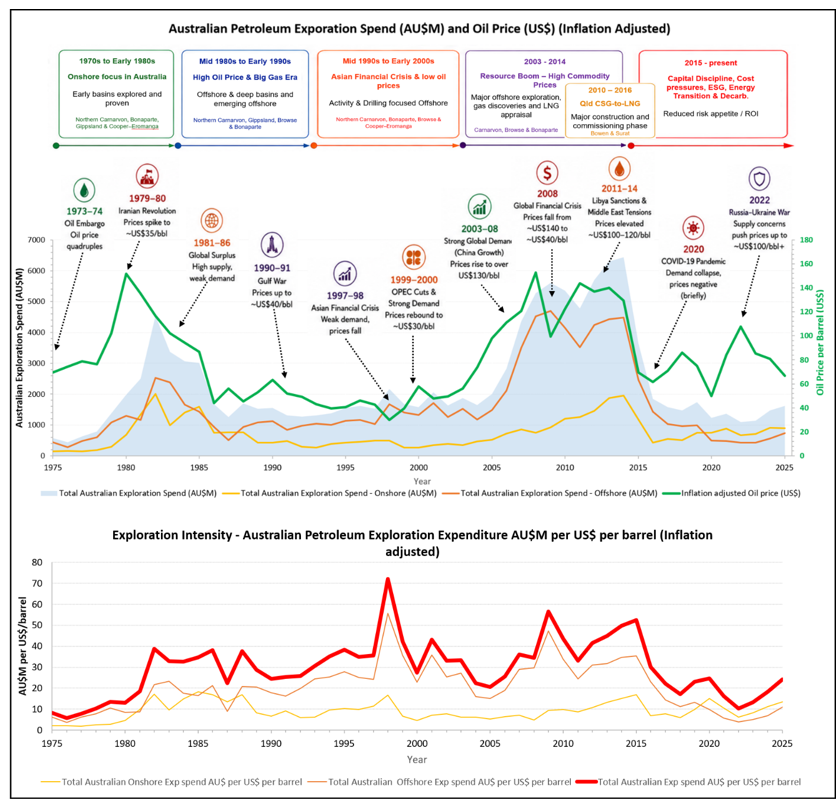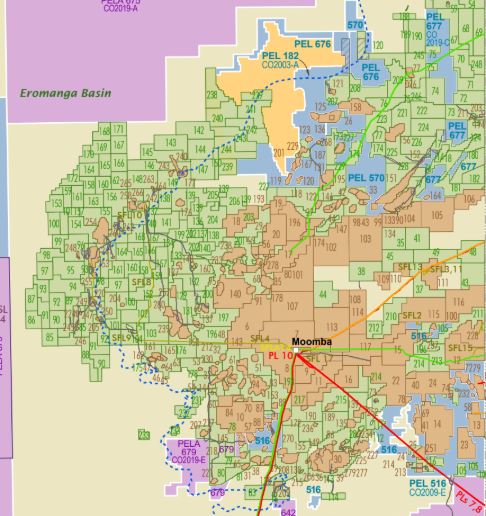

Our AEP 2026 peer-reviewed paper - Understanding exploration success and failure in the Cooper and Eromanga Basins, South Australia - presents an integrated analysis of open-file well, production, and licensing data to understand the drivers of exploration success and failure. Some 800 exploration wells (Figure 1) have resulted in production of approximately 260 million barrels of oil and 8 trillion cubic feet of raw gas, confirming the basins’ status as a significant onshore petroleum province.
PESA


Cooper Basin – seismic processing & where it leads
By Paul Strong, SA/NT Branch President
On 30 April 2026 the PESA SA/NT Branch held a joint meeting with the ASEG, listening to an interesting talk by consultant Peter Strauss regarding the processing of seismic data in the Cooper Basin, a topic that would be expected to be well known.
Peter challenged the conventions on seismic processing onshore Australia, with modern land 3D seismic datasets often not being fit-for-purpose when targeting smaller-scale structures, with some wells probably not having been drilled in the right place.

Update on Gold Hydrogen’s drilling on the Yorke Peninsula
By David Spence, Beach Energy
On 28 May 2026 the PESA SA/NT Branch received a fascinating talk on the technical geological side of hydrogen exploration from industry leader Peter Buberndorfer, Chief Geologist of pioneering hydrogen exploration company Gold Hydrogen.
The attendees were taken on a 2-billion-year ride through the regional geology of South Australia. Peter discussed the regional Proterozoic strata that are favourable for hydrogen generation along the boundary of the Gawler Craton.

AEP: PESA Year in Review 2025
The PESA year in review session at this year's AEP in Adelaide was a popular event, with a crowd coming to hear insights from the PESA speakers. The speakers this year were: Martin Wilkes from RISC Advisory talking about Production and Development; Anne Forbes from Wood Mackenzie talking about the Business Environment, and; Andrew McKerron from PESA SA/NT branch talking about Exploration.
You can read their abstracts below and access their extended AEP abstracts via the PESA Library. Each speaker will be giving a version of their talk in an upcoming webinar with details below.
Access the AEP Extended Abstract here.

PESA Queensland May Meeting
By Sue Slater, PESA Queensland Branch President
On Thursday 28 th May PESA Qld held their second technical lunch for 2026. Comet Ridge’s Tor McCaul and Mel Fitzell gave a capacity crowd an update on the Mahalo Gas Hub project.
Comet Ridge has secured a significant acreage position at the Mahalo Gas Hub in the southern Bowen Basin. This region is shaping up to be a major gas production hub for the east coast, with proven ommercial production rates, development-ready 2P gas reserves, and excellent access to key infrastructure to domestic and LNG export markets.

2026 PESA AGM and AEP
Our 2026 AGM was held on Monday 18th May in Adelaide. It was smooth sailing through the official parts, and we were happy to celebrate the announcement of our 2026 Barry Goldstein Award winner; Professor Ken McClay.
We also handed over the 40-year (!!!) continuous membership certificate to Mick Small. All other certificates were taken by the Branch Presidents to be handed over at Branch events throughout the year.
The PESA conference booth was organised and staffed by volunteers from the SA/NT Branch, as well as a number of interstate members.

WA acreage release nominations now open
May 28th saw WA Mines and Petroleum Minister, David Michael, open nominations for Western Australia’s 2026 acreage release, inviting industry to put forward areas for petroleum and greenhouse gas storage exploration.
For the first time, the program includes regulated substances such as hydrogen and helium, as well as potential greenhouse gas storage locations, expanding the acreage release to include these emerging industries. The changes take effect from 28 May 2026 under the Petroleum Legislation Amendment Act 2024, modernising the State’s regulatory framework and providing new titling pathways.
They also cover activities for the transport and permanent injection of carbon dioxide once a storage site is declared.

True Stratigraphic Thickness – Where and Why It Matters
Prepared for PESA by Lawrence Grant-Woolley, Senior Geologist at Todd Energy
Lawrence Grant-Woolley is a development geologist with more than 27 years petroleum geology experience working offshore and onshore with clastic and carbonate reservoirs. Currently working as a Senior Geologist at Todd Energy, his career has spanned the globe with time spent working in Aberdeen, Oman, Jakarta and Adelaide. This article was inspired by a recent presentation given at a TNav Technology Summit in Brisbane.
In recent years I have worked steeply dipping complex structured fields. Review of existing models and correlations reinforced the need for True Stratigraphic Thickness (TST).

Vale Farah Fazulah Abdullah
It is with great sadness that PESA Queensland shares news of the passing of our former colleague and friend, Farah Fazulah. Farah joined PESA when she moved to Australia and volunteered with the Queensland branch from 2023 before joining the PESA Queensland Committee in early 2024. Bringing her energy and enthusiasm to supporting with technical lunches and other committee events and helping to man the booth at AEP Brisbane in 2025, her energy was shared with the broader federal committee and PESA membership.
Farah moved to Australia and joined Central Petroleum as a geologist in 2021, focused on the Amadeus Basin in the Northern Territory.

New Exploration areas opening in NSW
The Minns Labor Government will open new areas for gas exploration in NSW for the first time in more than a decade, taking decisive steps to secure the State’s energy supply for households and businesses.
Two regions in the state's Far West – the Bancannia and Pondie Range Troughs – will be opened for gas exploration. These opportunities for new gas supply will complement the Narrabri Gas Project.
To attract investment and ensure NSW remains competitive with other states, the Government will also update regulations to reduce the gas exploration licence application fee from $50,000 to $1,000.
Not all exploration licences proceed to gas production.