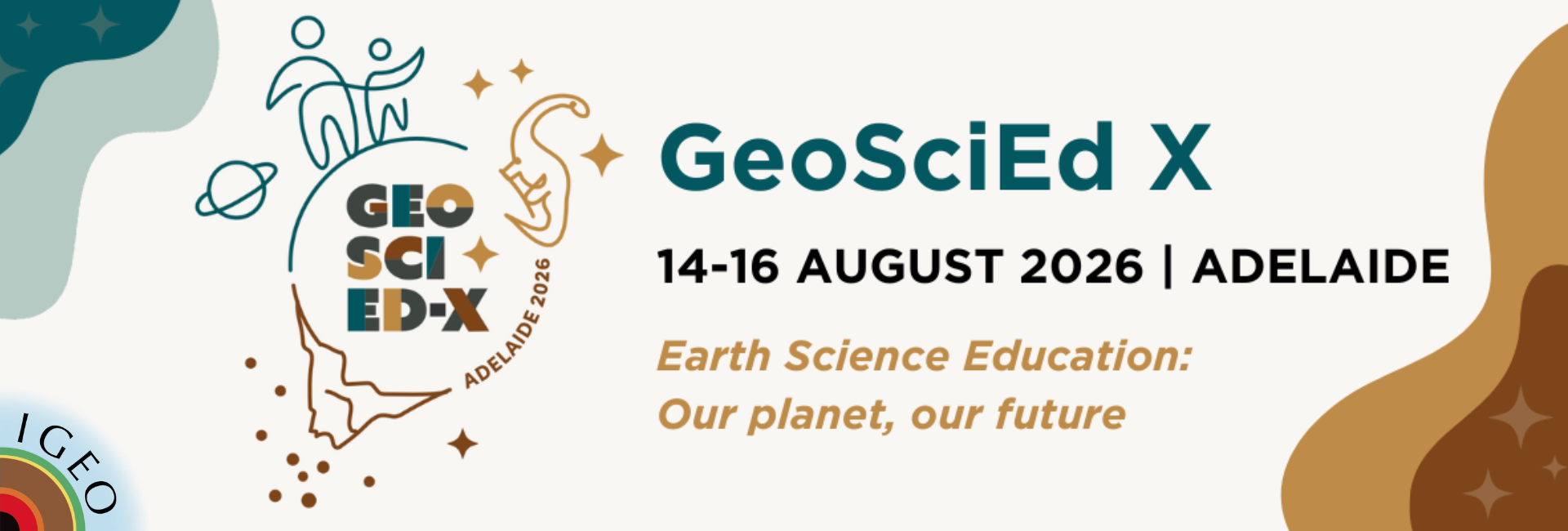
In August, Adelaide hosted GeoSciEd X, the 10th International Conference on Geoscience Education, held at Adelaide Botanic High School from 14 to 16 August. PESA was proud to be a sponsor, and I was fortunate to attend.
This was a truly international gathering. Delegates travelled from the United States, Canada, Namibia and Japan to join colleagues from across Australia, and with more than 120 educators, researchers and industry representatives in attendance, the conference was very well supported.
The highlight for me was the opening field trip to Hallett Cove. Delegates split into primary, secondary and tertiary streams to explore one of South Australia’s best-known geological sites, where striated glacial pavements record Permian ice moving across Neoproterozoic bedrock. Standing on that pavement drove home something every geoscientist knows but classrooms struggle to replicate: there is no substitute for seeing real rocks. Observation, questioning and interpretation happen in the field in a way no textbook or screen can match.
I was also struck by the number of organisations, many of them non-profits, supporting geoscience education at every level, from primary school through to university. Groups such as the CoRE Learning Foundation, which co-chaired the conference, and Australian Earth Science Education (AusEarthEd) are doing vital work inspiring the next generation, often with limited resources.
That matters to our industry. With interest and enrolments in geoscience declining, the pipeline of future geoscientists starts in primary and secondary classrooms. Supporting the educators and organisations who build that pipeline is an investment in our future.
GeoSciEd X was a thoroughly worthwhile conference. Congratulations to the Australian Geoscience Council and the organising team on a great event.