
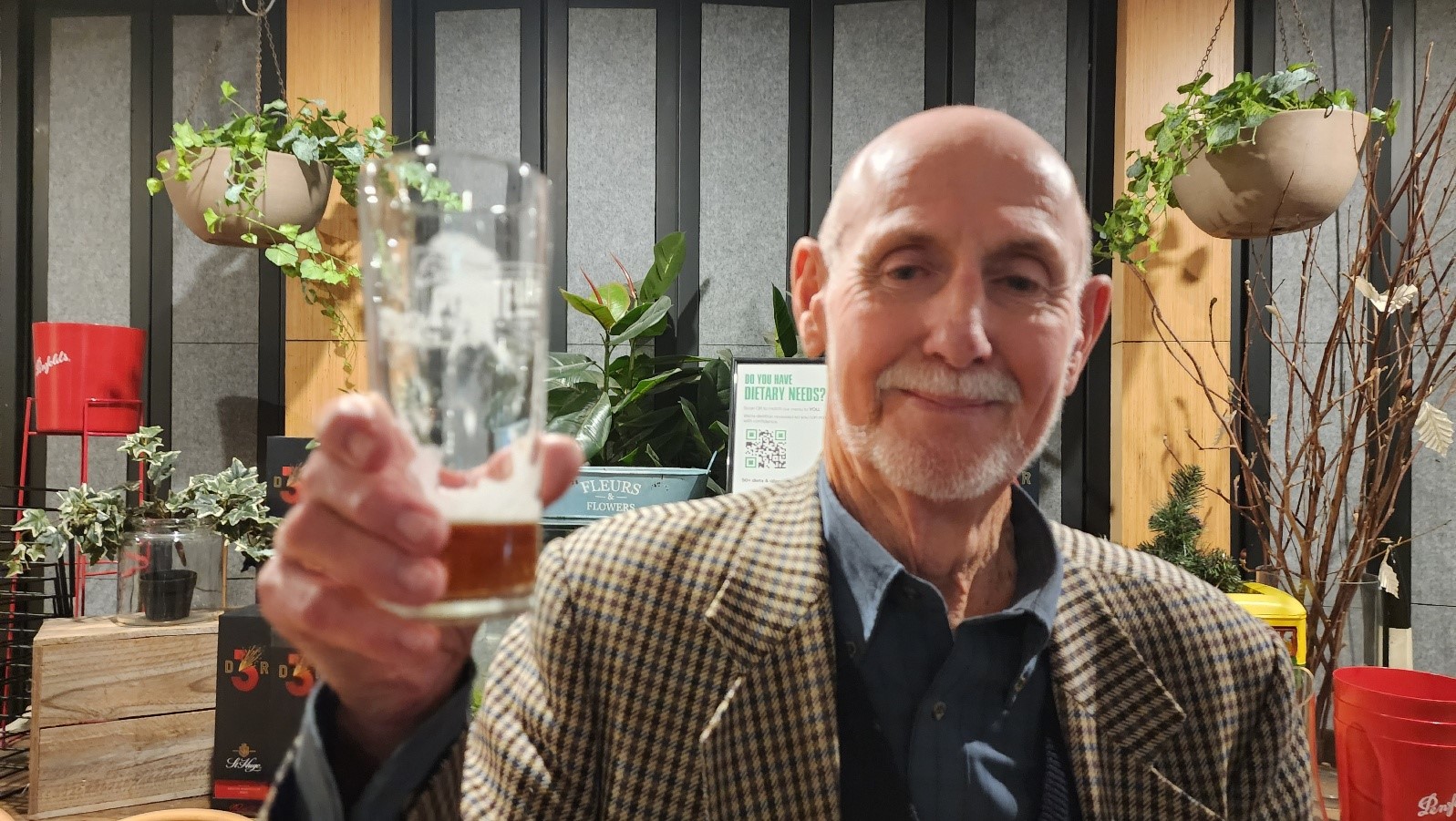
Vale Vincent Paul St John. Ph.D. 19.10.1947 to 16.11.2025
Long-standing PESA VIC/TAS Member, Geophysicist, Company Founder, and Mentor
PESA notes with deep sadness the passing of Dr Vincent Paul St John (“Paul”), who died peacefully at home in Albert Park, Victoria, on 16 November 2025, aged 84. Paul was a PESA VIC/TAS member for more than fifty years, first joining the Society in 1974. During that time, he contributed as an explorer, a quiet volunteer, a vigorous debater, and a distinctive and memorable presence at countless lunchtime meetings.
Paul was born in Western Australia in 1941 and after gaining a first class Honours Degree at UWA, completed his PhD at the University of Tasmania in 1967 under the guidance of Professor S.W. Carey. His doctoral work on gravity and topography in eastern Papua New Guinea set the direction for a career deeply anchored in the geological challenges of the Papuan region. He published several early papers on potential field interpretation and maintained a lifelong interest in the structural and tectonic evolution of PNG.
In 1968 he joined British Petroleum (BP) in Melbourne, was posted to London, Peru and BP Carigali in Malaysia. In 1973 he was seconded to Australasian Petroleum Company based in the BP Pet Dev Australia office in Melbourne at a time when much of PNG remained unmapped and operationally difficult. Paul distinguished himself quickly through his capability in gravity methods, his tolerance for remote fieldwork, and a dry wit that remained a hallmark of his professional style. Colleagues from this period recall both his geophysical competence and a talent for turning even routine operational setbacks into entertaining stories.
His PNG work in the 1970s and management in the 1980s spanned seismic, gravity, and aeromagnetic programs across PNG and included the first (and only) vibroseis survey in PNG. Whether despatching teams into the remoter jungles of PNG or first-hand dealings with impromptu interactions with local “raskals” on the outskirts of Port Moresby, Paul treated each challenge as both a scientific problem and an inevitable part of the profession he loved.
In 1983 Paul co-founded Southeastern Oil & Gas Pty Ltd, a privately funded joint venture that undertook ambitious exploration across initially PNG and Queensland. His scientific leadership emphasised rigorous field geology, careful structural interpretation, and a willingness to pursue unconventional ideas when he believed the data justified them. The SEOG venture subsequently led to the creation of Austin Oil NL, which, under Paul’s leadership as Managing Director, held one of the largest petroleum acreage positions in PNG through the late 1980s and early 1990s. Although Austin did not achieve a major commercial discovery, the company’s work substantially advanced geological understanding of several key Papuan Basin regions, including the foreland and fold belt. Paul himself oversaw or contributed to numerous surveys, stratigraphic analyses, and prospect evaluations during this period.
He remained unafraid to challenge established thinking. In 2019 he wrote to the Australian Senate regarding proposed amendments to the PRRT Act, highlighting international comparisons — particularly with Norway — and emphasising the need for more effective national benefit from resource development. His letter, characteristic of his direct and occasionally provocative style, reflected his enduring commitment to the long-term value of Australian geoscience.
Alongside his technical contributions, Paul was a constant and much-valued figure within the PESA VIC/TAS branch. For many years he volunteered after lunchtime meetings, gathering the “not-quite-empty” wine bottles to ensure they were disposed of safely — a task he approached with characteristic thoroughness. His conversations ranged widely, from gravity modelling to classical literature, and he took particular pleasure in engaging with younger professionals, offering advice that was equal parts wisdom, humour, and gentle provocation.
In retirement Paul continued to attend branch meetings, technical talks, and social events until shortly before his final illness. Members will remember not only his depth of geological knowledge but also his checked jacket — rumoured to be as old as his PESA membership — his tap-dancing stories, his unexpected television appearances, and his steadfast loyalty to former colleagues. He remained a man of wide interests: an enthusiastic participant in community activities, a quiz-night regular (arts: strong; sport: weak), and an avid reciter of poetry at moments both appropriate and unexpected.
Paul is survived by his sons Julian, Jeremy, and Alexander, his granddaughter Emelia, his brother Bernard, and the extended St John and Cameron families. He was predeceased by his beloved wife Alison (née Cameron), with whom he shared a long and close partnership.
The VIC/TAS branch, and PESA more broadly, acknowledge Paul’s many contributions to Australian petroleum geoscience. His work in PNG helped build foundational geological understanding for subsequent exploration successes, and his long-term involvement in the Society enriched the professional and social fabric of the branch.
The geoscience community will miss Paul’s sharp intellect, his humour, his generosity, and the distinctive mix of seriousness and playfulness that made him one of the memorable characters of Australian petroleum exploration. We extend our condolences to his family, friends, and former colleagues.
May his memory, like the best of the geological record, be well preserved and frequently revisited.
Compiled by George Carman (his coworker for 10 years)
Nick Hoffman
PESA VIC/TAS branch president.
Related Articles

15/08/2024
26/07/2021

10/12/2024