Australia’s power market is now the most volatile in the world as unexpected losses of supply from unplanned coal generation outages and transmission line issues related to natural disasters lead to huge price fluctuations, according to Rystad Energy research.
The country’s National Electricity Market (NEM), which interconnects power markets in Queensland, New South Wales (NSW), Victoria, Tasmania and South Australia is experiencing the most fluctuations in daily prices of any system worldwide.
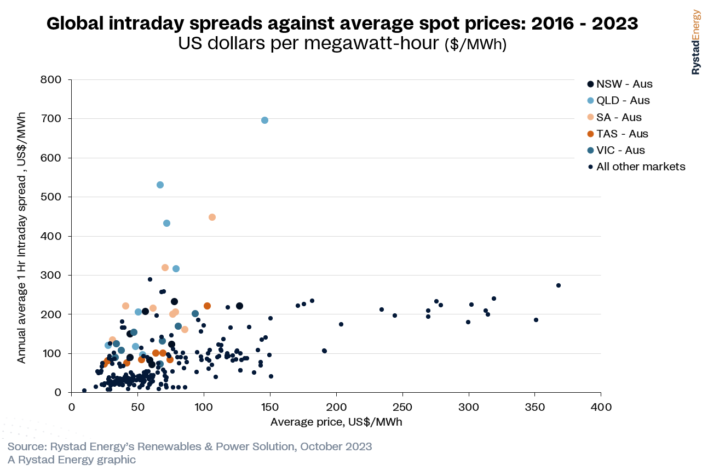
Rystad Energy has analyzed public price data from 39 electricity markets globally and concluded that Australia’s NEM holds the unwanted title of ‘most volatile’, with domestic price spreads for Queensland and South Australia seeing the widest spreads of all markets. The key metric used to measure volatility is the average one-hour intraday spread for a year of data, i.e., the difference between the highest and lowest price during a given hour.
Volatility is driven by significant supply issues, including unplanned coal power plant outages or transmission line problems caused by natural disasters such as cyclonic winds or bushfires, which have become more frequent and devastating in recent years. Extreme price fluctuations are also down to high solar power penetration. While daytime generation is high, pushing prices down, elevated natural gas prices are causing soaring rates in the evenings and at night when solar generation falls and gas-fired generation is needed.
To handle these fluctuations, increased storage capacity is required. A total of 46 gigawatts (GW)/640 gigawatt-hours (GWh) of pumped hydro and utility-scale battery storage capacity will be needed to balance the market by 2050, a significant increase from the current 2.8 GW.
Outside Australia, the other markets that exhibited high volatility in our research were Japan and the Philippines, plus select regions of the US such as California and Texas.
“Volatility can be unsettling for retailers who lack proper hedging strategies and for consumers who bear the brunt of resulting cost fluctuations. To tackle this, Australia should prioritize the enhancement of transmission infrastructure and invest in storage solutions to mitigate the impact of volatility. This will help to create a more stable and affordable electricity market for all Australians,” says David Dixon, senior analyst with Rystad Energy.
For September 2023, prices across all NEM states remained low as mild weather conditions reduced electricity demand. However, the northern states of NSW and Queensland bucked this trend, experiencing higher prices of A$69 (US$44) per megawatt-hour (MWh) and A$56 per MWh, respectively.
Conversely, electricity prices were more affordable in other states, hovering around A$44 per MWh in South Australia, A$34 per MWh in Victoria, and A$32 per MWh in Tasmania. Surprisingly, even in the face of these low prices in September, volatility continued to persist in South Australia, NSW and Queensland. This was evidenced by half-hour intraday spreads surpassing A$440 per MWh in all three states, despite the season being characterized by mild weather and, consequently, reduced demand.
Solar the star: renewables generation growth excels down under
In September 2023, renewable energy generation in the NEM saw significant growth, with solar leading the way. The total renewable energy output reached 7 terawatt-hours (TWh), up 13% year-on-year. Solar accounted for most of this increase, generating 1 TWh more than in September 2022. Wind generation remained steady year-on-year, while hydro generation dipped slightly.
In September, NSW topped the list for utility solar PV generation, producing 650 gigawatt-hours (GWh). Nationwide utility PV generation reached 1,331 GWh, a substantial 41% year-on-year increase. NSW hosted 14 of the top 20 utility PV assets, with the Edenvale solar farm in Queensland, which is jointly owned by Eneos and Sojitz and has a capacity factor (operational efficiency) of 35%, claiming the top spot.
Wind generation in September totaled 2,488 GWh, a 1% increase compared to September 2022. The top-performing wind assets were located in Queensland and Tasmania, with Prime Super’s Morton’s Lane wind farm the only exception outside of these regions. At a state level, Victoria led wind generation with 874 GWh, followed by South Australia (464 GWh) and NSW (456 GWh).
Coal curtailed: historic lows noted as spring comes into sight
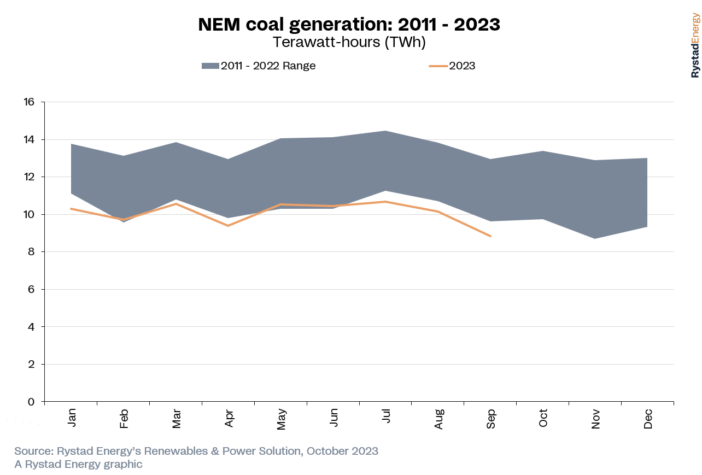
Coal-fired generation in the NEM and Western Australia’s isolated Wholesale Electricity Market (WEM) remained low in September this year, compared to recent norms. This was due to a combination of seasonal factors, increased renewable generation and outages at some coal-fired generation facilities.
Total output from coal-fired generation reached 0.36 TWh in September, compared to the September all-time low of 0.35 TWh set in 2022. In the NEM, coal generation facilities generated a total 8.8 TWh, below the 11-year historical range (2011-22). This downward trend was also visible in Western Australia’s WEM.
Spring is typically a seasonally low period for coal generation in the NEM and the WEM, due to milder conditions leading to lower demand and greater solar generation resources, resulting in increased supply from cheaper renewables. At a state level, Victoria’s coal power fleet operated at a capacity factor of 74%, with NSW at 55% and Queensland at 61%. It is worth noting that Callide B turbine 2, Callide C turbine 1 & 2, Bayswater turbine 1, Yallourn West turbine 3 and Eraring turbine 2 were all offline in September, totaling 3.0 GWac of capacity, or 14% of the NEM’s coal-fired generation capacity.
In Western Australia, the WEM’s coal fleet operated at a capacity factor of 34% in September, despite all coal power facilities being operational for the month.