

- This event has passed.
Joint PESA – SPE WA Evening Event: 14 May 2026
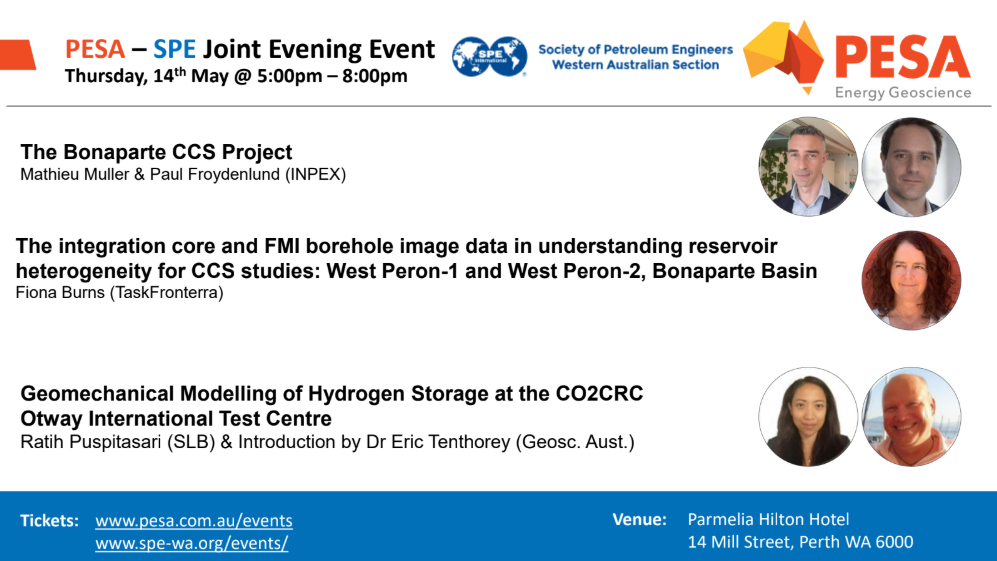
Joint PESA and SPE Evening Event
Thursday 14 May 2026 (5pm-8pm)
The Bonaparte CCS Project – Mathieu Muller & Paul Froydenlund (INPEX)
As part of its Vision 2035, INPEX is progressing carbon capture and storage (CCS) initiatives to support lower-carbon energy solutions. This presentation will provide an overview of INPEX’s global CCS strategy. It will also highlight the company’s efforts to decarbonise its upstream operations, including proposed development of the Bonaparte CCS Project – an initiative aimed at providing safe, permanent offshore CO₂ storage to support emissions reduction.
The Integration of Core and FMI Borehole Image Data in Understanding Reservoir Heterogeneity for CCS Studies: West Peron-1 and West Peron-2, Bonaparte Basin – Fiona Burns (Task Fronterra)
Core and FMI borehole image data from wells West Peron-1 and West Peron -2 provide a remarkable dataset for gaining insights into reservoir architecture and heterogeneity in the Jurassic to Cretaceous successions of the Bonaparte Basin. Such information is critical in the assessment of suitable sites for the long-term storage of CO2 in the Bonaparte Basin in terms of injectivity potential and movement of the CO2 plume (porosity, permeability, lateral and vertical heterogeneity).
This talk will focus on the Elang and Frigate formations, which comprise exceptionally thick successions of deltaic and shallow marine sediments with highly complex depositional histories. The high-resolution FMI data, calibrated with core, provides precise information on lithofacies, depositional environments and sediment-dispersal trends. The FMI data also assists in the interpretation of bedform architecture and channel-fill style. Integrated core and FMI data aids evaluation of the key controls on deposition i.e. river-, wave & and storm, – and tidal influences. This talk will summarise the evolution of both the Elang and Frigate formations, highlighting the dominant controls on deposition of these formations. This approach also provides an invaluable framework in which small-scale features that can cause baffles/barriers to fluid flow can be assessed e.g. tidal clay drapes, fluid-mud deposits, types and degrees of bioturbation, the presence of cemented layers and concretions.
Geomechanical Modelling of Hydrogen Storage at the CO2CRC Otway International Test Centre – Ratih Puspitasari (SLB) with an introduction by Dr Eric Tenthorey (Geoscience Australia)
Australia’s emerging hydrogen economy depends on the ability to safely store large quantities of hydrogen underground. As part of the national Exploring for the Future program, this study assesses the suitability of depleted gas fields for hydrogen storage, using the CO2CRC Otway International Test Centre as a representative site.
With natural gas and CO₂ storage far more extensively characterised, these systems provide essential reference points for understanding subsurface hydrogen storage behaviour. However, hydrogen’s distinct density, viscosity, compressibility, and thermal properties mean that established injection and storage practices from these gases cannot be assumed to apply directly. To investigate these differences, this study presents the first like‑for‑like comparison of hydrogen, methane, and carbon dioxide behaviour under identical reservoir conditions. A fully coupled reservoir–geomechanics–thermal model was developed for this purpose, incorporating high‑resolution wellbore grids to quantify pressure, temperature, and stress evolution.
Results show that hydrogen injection generates significantly lower thermal perturbations than methane or CO₂, reducing the likelihood of thermally induced fault reactivation and wellbore fracturing. Simulations also demonstrate that moderated injection rates further minimise thermal and pressure impacts, providing additional operational safeguards. The study underscores the importance of integrating flow modelling with geomechanical risk assessment and highlights how dynamic injection control strategies can enhance the safety and efficiency of future hydrogen storage projects.
Ticket Prices:
Member (Early Bird): $65.00
Member (Non-Early Bird): $75.00
CCUSNA Members (Early Bird): $65.00
CCUSNA Members (Non-Early Bird): $75.00
Non-Member: $90.00
Early bird pricing ends Wednesday 6 May at 5pm (AWST). All ticket sales close at 11am Monday 11 May. No further tickets will be allocated after this time.
Please note that this event will be held on Thursday 14 May at Parmelia Hilton (14 Mill Street, Perth) and will include food and drinks.
Hosted with thanks to our Platinum Sponsor:

and Gold Sponsor:

and Silver Sponsors:



and Bronze Sponsor:

Related Events
-
Tuesday, 20 October @ 5:30 pm - 7:30 pm (Australia/Perth time)
 WA
WA -
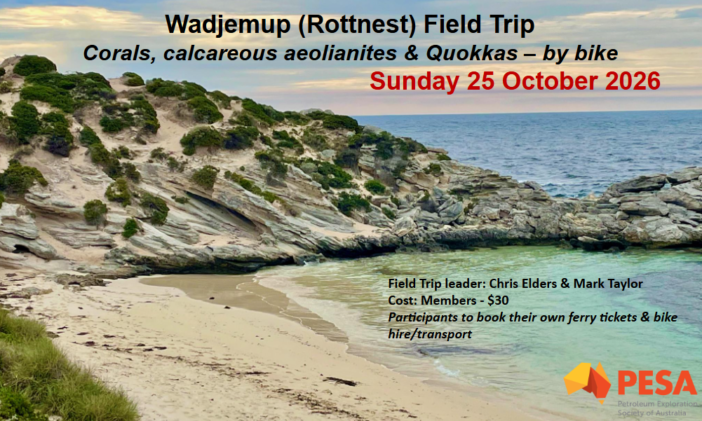
Sunday, 25 October (Australia/Darwin time)
 WA
WA -
Friday, 13 November (Australia/Perth time)
 WA
WA