

• Member Login
  • |
  • Join Now
PESA - Energy Geoscience

Promoting Professional and Technical Excellence in Energy Geoscience – Networking, On-going Professional Education, Monthly Technical Meetings

  • Home
  • About
    • About PESA
    • Objectives
    • PESA History
    • PESA Affiliates
    • Constitution and Rules
    • Strategic Plan
  • Events
    • Online
    • NSW / ACT
    • QLD
    • SA / NT
    • VIC / TAS
    • WA
    • Industry
    • Social
    • Past Events
  • Membership
    • Join Us
    • APPEA Conference Discounts
    • AEGC 2025 Travel Bursaries
    • PESA Membership Awards
  • Latest News
    • All News
    • Feature Articles
    • Industry
    • Company Updates
    • Tech Talk (public)
    • PESA Branch Activities
  • Library
    • Technical Library
    • PESA Gazette
    • Webinars
    • PESA News Magazine
    • Knowledgette Recordings
  • Scholarships
  • Employment
    • View Job Opportunities
    • Submit Job
  • Contact

GSQ Thargominda-3: a stratigraphic test of a ‘canyon-like’ feature near the Tookoonooka complex, Eromanga Basin, Queenland

17/12/1989 by Sharperedge

GSQ Thargominda-3: a stratigraphic test of a ‘canyon-like’ feature near the Tookoonooka complex, Eromanga Basin, Queenland


Download Section

Please log in to download this file.

Alternatively, you can search for this item and individually purchase it from the PESA collection at AAPG DataPages

PESA collection at AAPG DataPages

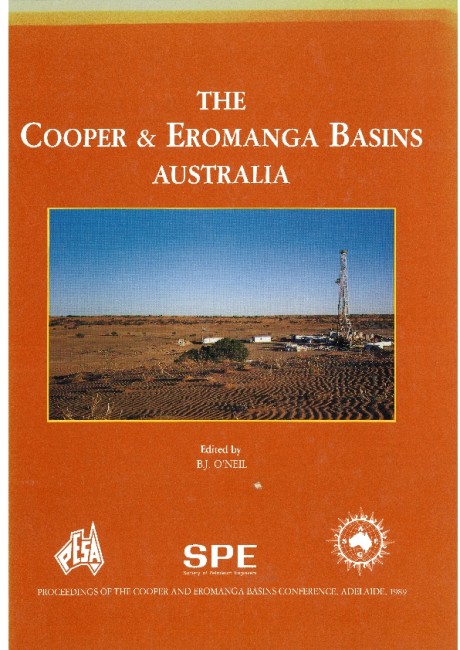
Publication Name: The Cooper & Eromanga Basins Australia

Authors: Ian F. Young, L.M. Gunther and O. Dixon

Date Published: June 1989

Number of Pages: 29

Reference Type: Book Section

Abstract:

GSQ Thargomindah-3, a fully cored stratigraphic bore, was designed to investigate seismic evidence of superimposed post-Westbourne and post-Cadna-owie channelling at a location 25 km south-east of the Tookoonooka Complex (south-west Queensland). It was sited on a deeply incised, arcuate trending 'canyon' that forms one of a series of such features that appear to encircle the Complex.
The well was completed in December 1987 and intersected a complete Eromanga Basin sequence from the
Early Cretaceous upper Westbourne Formation at rig limit to the Late Cretaceous Winton Formation. The lower
Wallumbilla Formation was highly atypical in that it comprised a zone, 115 m thick, of matrix supported diamictite. The diamictite contains intraformational sedimentary and subordinate metasedimentary clasts and
has been interpreted as a series of debris flows deposited during a period of active faulting in Aptian time.
The remaining Early Cretaceous units were similar to those encountered elsewhere on the northern
Thargomindah Shelf, a result inconsistent with the predrill interpretation of significant post-Westbourne erosion. However, these same units were intersected up to 140m deeper than at Toucaria-1, 2 km east, in an area where basement is essentially flat lying. Evidence of postdepositional faulting in the form of microfractures and slickensides, in addition to high angle bedding dips, support detached faulting as the likely mechanism to
reconcile both the well results and the anomalous seismic character.
Detached (listric) faulting may have commenced as early as Late Neocomian, contemporaneous with deposition of the Cadna-owie Formation, and was coincident with uplift of the Tookoonooka Complex. Consistent with the
astrobleme theory for development of the complex, faulting may be related to either gravitational collapse or
isostatic rebound following meteoritic impact.
The drilling of GSQ Thargomindah-3 was the outcome of a joint industry proposal, prepared by Delhi Petroleum
on behalf of the operators of five Authorities to Prospect in south-west Queensland. It demonstrates the benefits
of a combined approach by government and industry to assessing exploration areas that are both structurally and stratigraphically complex.

Tags: basin canyon-like Complex Eromanga feature GSQ Queenland stratigraphic Test Thargominda Tookoonooka

PESA - Energy Geoscience

PESA Energy Geoscience is a non-profit association of individuals involved in the exploration of oil and gas.

Connect with us

Subscribe to our newsletter and stay on the loop of what is happening in the field of Energy Geoscience and events near you.

pesa newsletter
* indicates required

PESA Energy Geoscience will use the information you provide on this form to be in touch with you and to provide updates and marketing. Please confirm you give us permission to contact you via your email address:

You can change your mind at any time by clicking the unsubscribe link in the footer of any email you receive from us. We will treat your information with respect. For more information about our privacy practices please visit our website. By clicking below, you agree that we may process your information in accordance with these terms.

We use Mailchimp as our marketing platform. By clicking below to subscribe, you acknowledge that your information will be transferred to Mailchimp for processing. Learn more about Mailchimp's privacy practices.

Copyright © 2025 PESA - Energy Geoscience. All Rights Reserved.

  • Advertise
  • Contact
  • Policies
  • Privacy
  • Terms & Conditions