

- This event has passed.
2026 PESA WEBINAR SERIES: Hybrid Contourite-Turbidite Systems from the Guyana-Suriname & Cote d’Ivoire-Ghana Deep Water Margins (Bryan Cronin)
2026 PESA Webinar Series
Kindly supported by Rock Flow dynamics 
The next webinar as part of the 2026 PESA Webinar Series will take place on Tuesday 21 July 2026.
This live webinar will take place at:
4pm – Perth
5.30pm – Darwin, Adelaide
6pm – Brisbane, Canberra, Hobart, Melbourne, Sydney
Use the calendar link on this page to add this event in to your own calendar at the correct local time for your location.
Tickets are free for members (please log in to see this) and $10 for non members.
Please buy your tickets and immediately follow the link in the ticket e-mail (not the calendar invite or this webpage, which is just generic and not event specific) to set up your registration with the webinar software well in advance of the time of the talk. Once registered with the webinar software you will receive a reminder e-mail 1 hour beforehand.
Hybrid Contourite-Turbidite Systems from the Guyana-Suriname & Cote d’Ivoire-Ghana Deep Water Margins: Impact on Slope Channel Complex Stacking, Frontal Splay Stacking, Mass-Wasting, Stratigraphic Trapping, and Field Development and Planning
Presented by Bryan Cronin
Abstract:
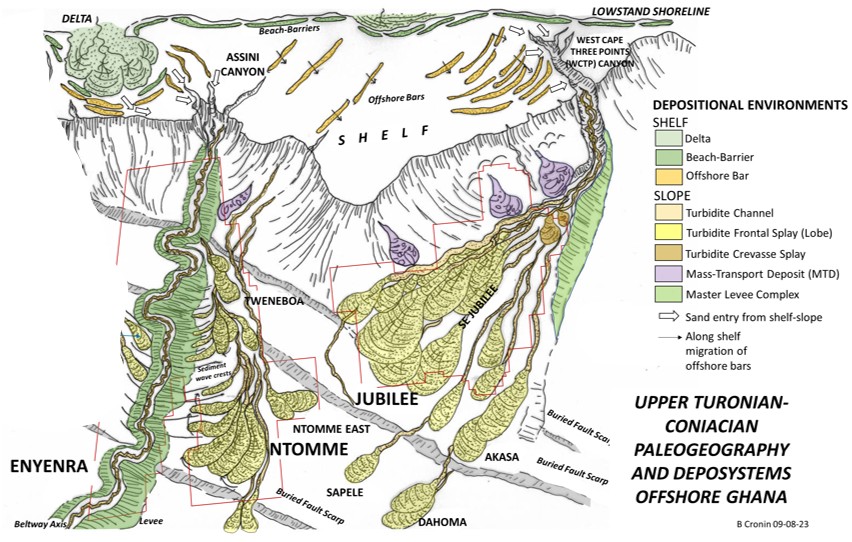
Deep-water slope and proximal basin floor turbidite systems along both the Guyana-Suriname and Cote d’Ivoire-Ghanaian margins have been strongly affected by contour currents since the latest Lower Cretaceous. These contour currents were (and are) usually counter-directional to surface ocean currents and longshore drift patterns that so strongly affect the distribution and movement of sand on the modern and geological pene-contemporaneous shelf areas. The latter longshore vector of sediment transport has thought to be the principal agent for sediment reworking, sorting by mechanical segregation and movement towards the heads of deep-water systems in both areas, with the wider shelfal areas contributing more to the reservoir-grade material going through the ‘spin cycle’ that ultimately controls primary fabric when it is resedimented through channels onto the slope and into deeper water. In the northern Gulf of Guinea, the sediment transport is and was to the east, whereas offshore Guyana and Suriname it was primarily to the west.
Contour currents, however, move in the opposite direction in slope and proximal basin floor settings. These currents impact on the down-slope moving turbidity currents by dislocating the fine suspended load from the flows and depositing them as sediment drifts or enlarged levees or sediment wave fields (or a combination of both) on the western sides of deep-water systems in the northern Gulf of Guinea, and the eastern parts of deep-water systems on the Guyana-Suriname margin. The impact is profound. Slope channel complexes that are the principal feeder systems to lobe systems outboard on both margins have highly asymmetrical constructional levees in the contour current direction, and subdued levees in the opposite direction. This impacts on slope channel complex behaviour by showing a steady westward or eastward stacking of the complexes (only one is active at any one time), in the direction of the subdued levee. Channel stacking patterns also reflect this asymmetry, with systematic high-angle lateral offset stack of reservoir channel elements towards the subdued levee. The second impact of the contour current generated asymmetric levee/flanking sediment drift fields is to increase local slope gradients at and near the levee crests, and this generates lateral channel complex margin collapse into the channel beltways (the highest gradient in the area, higher than the background slope gradient). It also promotes largescale MTD wasting of the outer levee flanks, and all slope channel complexes have associated MTDs on the same levee flanks (eastern on the Guyana-Suriname channel complexes for example).
The third impact of this channel complex asymmetry because of progressive stacking of channel elements within the beltway, and progressive stacking of the entire channel complexes in the same direction, is a mirrored progressive stacking of the outboard lobe complexes, both on intra slope terraces and on the basin floor. The overall behaviour is completely contour to notions of accommodation space controlling systematic stacking of deep-water channels and lobe complexes.
Exploration, development and production from a range of prospects and operating fields along both conjugate margins has yielded a fascinating repository of these types of behaviour from mixed turbidite-contourite settings that extend the observations seen on lobe shifting in the Rovuma Basin offshore Mozambique, and indeed outboard towards the Comoros. Designing line-developed injector-producer wells has necessitated very high angle well design predicated by the channel or lobe element stacking direction to maximise the sand face along hole, and this has been entirely as a result of the mixed turbidite-contourite influenced behaviour of the slope channel complexes and both intraslope and basin floor lobe complexes. The subsea infrastructure architecture: location of manifolds and the like, again controlled by the original geology, needs early alignment to capture the program and reduce cost of facility design and well trajectory complexity.