• Member Login
  • |
  • Join Now
PESA - Energy Geoscience

Promoting Professional and Technical Excellence in Energy Geoscience – Networking, On-going Professional Education, Monthly Technical Meetings

  • Home
  • About
    • About PESA
    • Objectives
    • PESA History
    • PESA Affiliates
    • Constitution and Rules
    • Strategic Plan
  • Events
    • Online
    • NSW / ACT
    • QLD
    • SA / NT
    • VIC / TAS
    • WA
    • Industry
    • Social
    • Past Events
  • Membership
    • Join Us
    • APPEA Conference Discounts
    • AEGC 2025 Travel Bursaries
    • PESA Membership Awards
  • Latest News
    • All News
    • Feature Articles
    • Industry
    • Company Updates
    • Tech Talk (public)
    • PESA Branch Activities
  • Library
    • Technical Library
    • PESA Gazette
    • Webinars
    • PESA News Magazine
    • Knowledgette Recordings
  • Scholarships
  • Employment
    • View Job Opportunities
    • Submit Job
  • Contact
Feature Articles
Industry

Long-term uncertainty over Russian oil and gas a ‘boom for the Middle East’

Posted by Dale | 14/03/2022

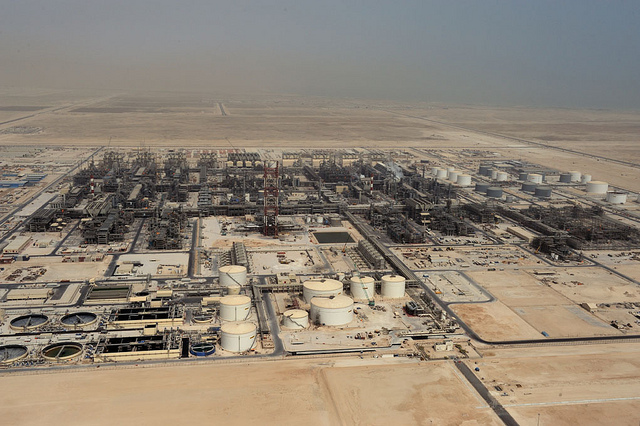
Shell Pearl GTL plant

14/03/2022 by Dale

share
share
tweet

Moscow’s decision to go to war in Ukraine has sparked a global energy crisis with an impact echoing the 1970s oil crisis that launched the Gulf’s first major economic boom.

Richard Thompson, Editorial Director at GlobalData’s MEED, said: “While the Gulf’s oil producers are keen to avoid taking sides in the Ukraine conflict, long-term uncertainty about Russian oil and gas supplies will sustain high energy prices for a prolonged period and create a renewed focus on Middle East hydrocarbons that will underpin a new economic and projects boom in the Gulf.”

The data and analytics company said the immediate impact of Russia’s invasion of Ukraine was to trigger massive volatility in global capital markets and a spike in commodity prices that has added to inflation fears already threatening the global recovery. However, the strategic impact of the crisis is to expose Europe’s overdependence on Russian energy, particularly its gas.

Consequently, the coming months and years will see a strategic realignment of global energy and a European diversification away from Russian oil and gas supplies to alternative sources such as renewables, coal, nuclear and Middle East hydrocarbons.

Thompson says: “In the longer term, unless a peace settlement is reached soon, Moscow’s actions in Ukraine will see Russian oil and gas exports reduced or even blocked altogether from the global energy supply chain.

“The scale and pace of the reductions will be shaped by the extent of Western embargoes on Russia’s oil and gas sales, which will further expose Europe’s dependence on Russia.” 

The mere prospect of oil and gas sales from the world’s third-biggest oil producer and second-biggest producer of natural gas being removed from the international market saw oil prices surge to nearly $138 a barrel on March 7—their highest mark since 2008, and some 45% higher than at the start of the crisis.

GlobalData’s MEED believes that high energy prices will be maintained for as long as the conflict continues and Moscow is sanctioned, and for as long as Europe is dependent on Russian energy. In the short term, the surge in oil prices delivers a financial windfall to Middle East oil producers, who will use the money to accelerate post-pandemic stimulus infrastructure in 2022.

Over the longer term, with rising inflation creating huge economic headwinds for the global economy, Middle East oil and gas will become increasingly vital to stabilise the energy markets.

Thompson added: “With its LNG expansion program underway, Qatar is well placed to become a major natural gas supplier to Europe, while Saudi Arabia, the United Arab Emirates (UAE) and the region’s other oil and gas producers are well positioned to increase their supplies of low-cost energy. Meanwhile, Libya, Iraq and Algeria will see renewed efforts to bring their hydrocarbons back on stream in a major way.

“The Gulf’s oil producers have abundant supplies of low-cost oil and gas reserves. They have proven themselves to be reliable and stable suppliers over the past four decades, and they are investing heavily to increase production capacity.”

Thompson concluded: “Their investment in renewable energy and future fuel technology, such as hydrogen, provides an important ‘green’ angle that aligns with international action against climate change, as well as the environmental, social and governance (ESG) criteria sought by multinational corporations and institutional investors.”

Related Articles

Drone attacks put petrochemical feedstock supply under strain

24/09/2019

GECF Ministerial Forum
GECF says gas has a bright future in a recovering COVID planet

06/12/2020

GECF Annual Workshop
‘Defining moment for the world on natural gas’: GECF Annual Workshop

05/10/2021

GECF Green LNG
Carbon neutral or Green LNG? GECF looks at the options

05/02/2021

Show CommentsHide Comments

Become a Member

petroleum exploration society member badge

Join PESA now and enjoy full membership benefits

  • access to fully searchable technical library
  • extensive networking opportunities with industry leaders and peers
  • further professional education and training
  • and more!

VISIT MEMBERSHIP PAGE

View Upcoming Events By Branch

PESA Events by State PESA Events in Western Australia PESA Events in South Australia and Northern Territory PESA Events in Victoria and Tasmania PESA Events in NSW PESA Events in Queensland

(Click on the the map)

Sponsored

PESA MAGAZINE – LATEST EDITION

PESA News Issue 173

Previous Editions

POPULAR POSTS

  • Shell Discovery Map WA Shell makes ‘significant’ gas discovery offshore Australia
  • APPEA CEO Samantha McCulloch Meet Samantha McCulloch, APPEA’s new CEO
  • USA oil exports exceeded imports 2019 How the USA became the world’s largest crude oil exporter in 2019
  • PESA WA Winter warmer at the Museum
  • SA announces successful applicants for acreage in Cooper and Otway Basins
  • CUE Permits NWS Ironbark exploration well delivers a disappointing duster

Norwood Resources

the Norwood resource

PESA members please use this group to help with "social license to operate" issues.

TOPICS

AEP Annual General Meeting Archer AVO AVO inversion Barry Goldstein Award Bowen inversion Branch News Bruce Ainsworth climate change complex seismic wavefield core workshop Dorado Early Triassic eFWI elastic full waveform inversion Energy Geoscience GA Golf Henry Posamentier Industry News Middle Triassic Mungaroo inversion NWS inversion PESA petroleum cores Qld Queensland CSG Queensland gas SA/NT Scholarships seismic inversion sequence boundary Social Surat-Bown Basin systems tracts WA wave influenced deltas WEB-AVO inversion women in energy women leadership women leadership scholarships womens career development women scholarships Zillmere core store

PESA - Energy Geoscience

PESA Energy Geoscience is a non-profit association of individuals involved in the exploration of oil and gas.

Connect with us

Subscribe to our newsletter and stay on the loop of what is happening in the field of Energy Geoscience and events near you.

pesa newsletter
* indicates required

PESA Energy Geoscience will use the information you provide on this form to be in touch with you and to provide updates and marketing. Please confirm you give us permission to contact you via your email address:

You can change your mind at any time by clicking the unsubscribe link in the footer of any email you receive from us. We will treat your information with respect. For more information about our privacy practices please visit our website. By clicking below, you agree that we may process your information in accordance with these terms.

We use Mailchimp as our marketing platform. By clicking below to subscribe, you acknowledge that your information will be transferred to Mailchimp for processing. Learn more about Mailchimp's privacy practices.

Copyright © 2025 PESA - Energy Geoscience. All Rights Reserved.

  • Advertise
  • Contact
  • Policies
  • Privacy
  • Terms & Conditions