

- This event has passed.
PESA WA October Technical Evening: Three-Dimensional Architecture of Wave-Dominated Delta Deposits

Guest Speaker(s): Brian J. Willis
Brian has been studying the bedding architecture and preserved facies patterns within fluvial and shallow marine outcrop deposits for four decades. Brian has particular expertise in using process-based depositional models to understand 3D facies patterns better and in applying stratigraphic concepts and facies patterns to improve reservoir models for subsurface assessments. In the early part of his career, Brian held academic positions at the Smithsonian Institution, the University of Texas at Austin, and Texas A&M University. Later, he worked for 17 years as a research geologist at the Chevron Technology Center in Houston. He has a long history of leading industry and academic stratigraphy training courses and has an extensive publication record.
Hosted with thanks to our Platinum sponsor SLB:

Gold Sponsors IKON Science:

and Silver Sponsors Delft, Qeye, Totum Compliance, Core Laboratories and Task Fronterra Geoscience:





PESA WA invites you to our technical evening on Thursday 2nd October.
Supported by Santos Ltd.
Three-Dimensional Architecture of Wave-Dominated Delta Deposits
Presented by Brian J. Willis (Willis Geoscience)
New numerical wave-influenced delta depositional models are challenging long-held rational for interpreting sea level variations recorded by wave-dominated shallow-marine successions. Shallow-marine, wave-dominated deposits (parasequences) are generally inferred to exhibit a decrease in wave energy and grain size with increasing water depth and to occur in facies belts that are laterally continuous for long distances along strike. Bedding geometry and vertical facies successions within these parasequences are interpreted in relation to a prograding equilibrium shoreface profile (cf. Bruun rule) and a gradual upward-coarsening facies progression (cf. Walther’s law). Sea-level fall is commonly inferred to generate a sharp-based shoreface succession, characterized by an abrupt vertical transition from heterolithic lower shoreface to sandy upper shoreface deposits across a marine erosion surface. A truncated vertical shoreface succession, capped by a marine erosion surface, is inferred to record significant wave ravinement during sea level rise and transgression.
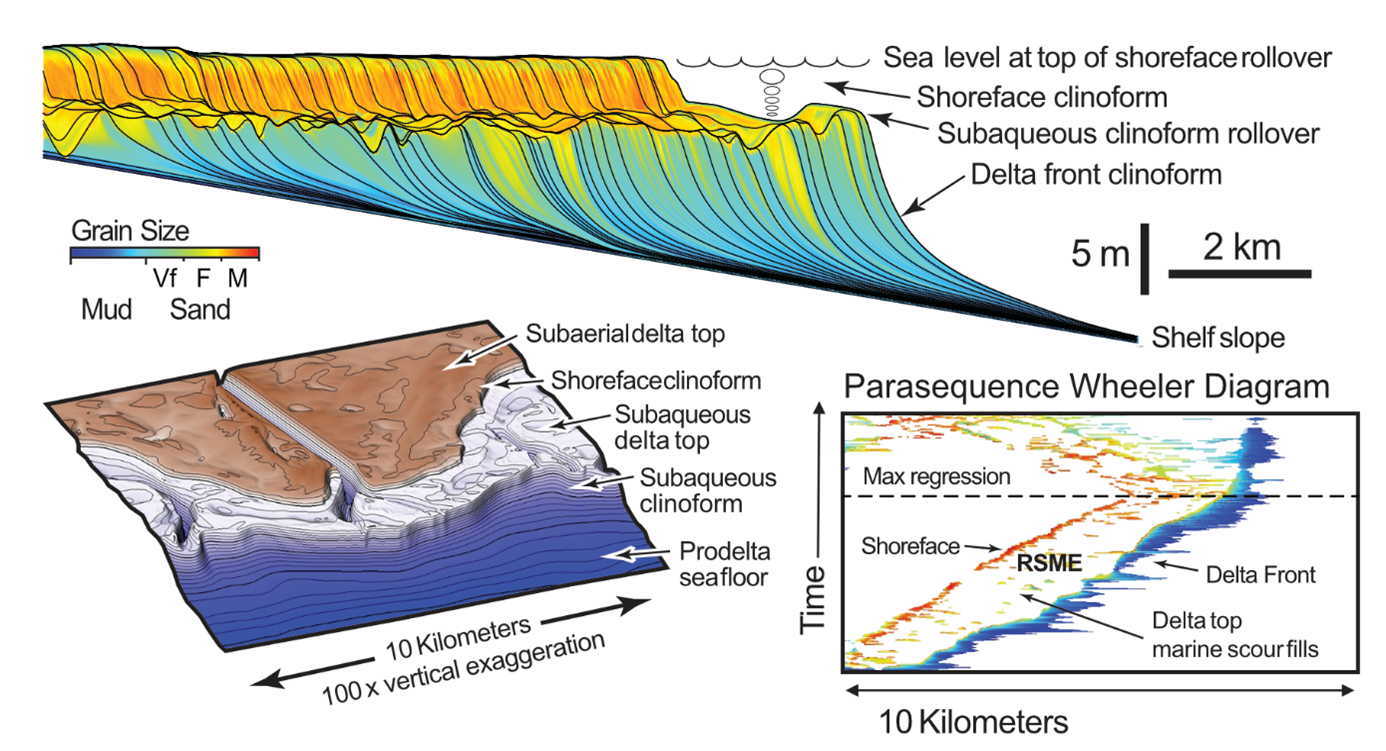
Three-dimensional, process-physics-based, coupled hydrodynamic-morphodynamic wave-influenced delta models suggest that wave-dominated deltas will develop a sandy shoreface inner clinoform dipping from the subaerial delta plain to a relatively flat wave-scoured subaqueous delta top, which is laterally separated from a muddier delta front outer clinoform that dips from the subaqueous delta top edge to the shelf floor. As these systems prograde, deposits of these dual-clinoforms will become vertically stacked and will be separated by a regressive surface of marine erosion formed on the subaqueous delta top. Grain-size contrasts between these vertically stacked clinoform deposits reflect differences in sediment-transport directions and sorting under river- and wave-driven littoral currents along the coast, and cannot be uniquely related to sea-level changes. Gradual vertical facies successions develop where waves are less effective at reworking river-supplied sediment alongshore. In contrast, sharp-based shoreface deposits record more effective wave separation of sands onto the shoreface clinoform as muds are preferentially transported offshore onto the subaqueous delta clinoform.
The continuity of a regressive surface of marine erosion over many tens to hundreds of kilometres across mid-shelf regions of some stratigraphic sequences reflects a gradual lateral shift in the position of littoral current erosion on a subaqueous delta top. Timelines cross such vertical lithic discontinuities throughout the extent of a prograding deposit, and the regressive surface of marine erosion thus has little chronostratigraphic significance. The model results are used to suggest: 1) Characteristic strongly asymmetric wave-dominated parasequences suggest common river avulsion at the start of transgression, 2) Observed down-dip transitions from “gradual-based” to “sharp-based” shoreface deposits might record reduced sediment supply to the coast relative to rates of longshore drift as the system expands toward its auto-retreat limit, rather than transitions from normal to forced regression, and 3) Regional “top-truncated” shoreface successions might record progradation of dual-clinoform shorelines with wide deviation in net direction of regional sediment supply and shallow-water wave transport, rather than significant regional transgressive ravinement. The results of these models suggest caution in inferring sea-level changes from the character of vertical facies changes observed in individual well logs and isolated outcrop exposures. The models suggest new facies relationships that require testing in modern systems, outcrops, and subsurface examples.
Ticket Prices:
Member: $25.00
Student Member: $10.00
Non-Member: $50.00
Student Member pricing ends Thursday (1 week prior) at 5pm (AWST).
Related Events
-
Tuesday, 10 March @ 12:00 pm - 2:30 pm (Australia/Sydney time)

-
Tuesday, 17 March @ 6:00 pm - 8:00 pm (Australia/Perth time)
 WA
WA -
Monday, 18 May - Thursday, 21 May (Australia/Perth time)
 SA/NT
SA/NT