

- This event has passed.
2025 PESA WEBINAR SERIES: Unlocking the Digital Twin of Wellbore Geology: AI-Powered Cuttings Data (Alex Fuerst)
Kindly supported by Rock Flow dynamics 
This live webinar will take place at:
11am | Perth
12.30pm | Darwin
1pm | Brisbane
1:30pm | Adelaide
2pm | Canberra, Hobart, Melbourne, Sydney
Use the calendar link on this page to add this event in to your own calendar at the correct local time for your location.
Tickets are free for members (please log in to see this) and $10 for non members.
Please buy your tickets and immediately follow the link in the ticket e-mail (not the calendar invite or this webpage, which is just generic and not event specific) to set up your registration with the webinar software well in advance of the time of the talk. Once registered with the webinar software you will receive a reminder e-mail 1 hour beforehand.
Unlocking the Digital Twin of Wellbore Geology: AI-Powered Cuttings Data
Presented by Alex Fuerst (Molyneux Advisors)
Abstract
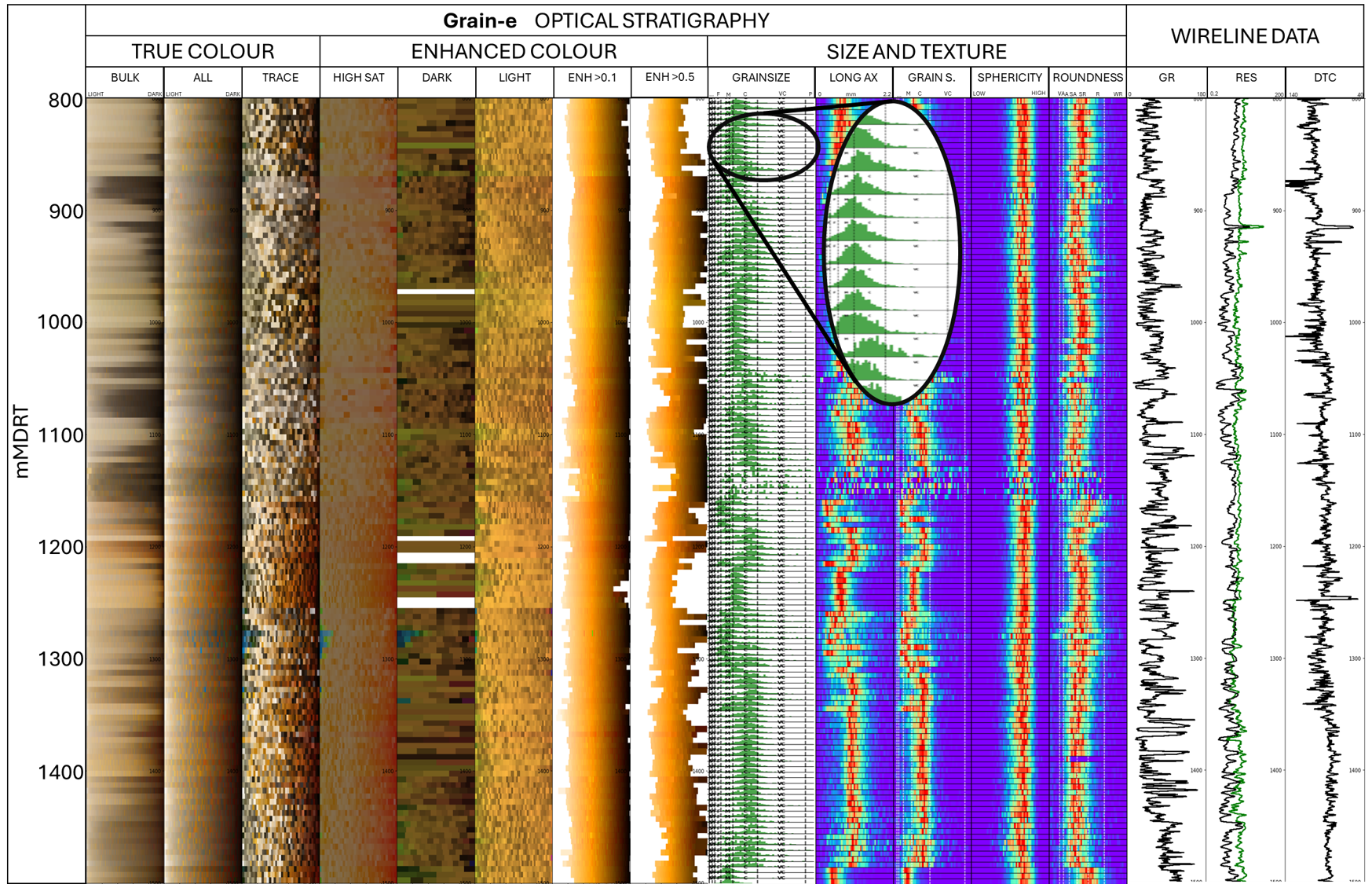
This webinar introduces the power of AI to transforms drill cuttings into comprehensive digital datasets for wellbore characterisation. By systematically digitising legacy and modern cuttings through automated washing, high-resolution imaging, and advanced segmentation algorithms, Grain-e extracts quantitative data traditionally captured only through qualitative wellsite descriptions.
Using a variety of AI workflows to identify and measure individual grains, providing unbiased statistical analysis of grain size, sorting, sphericity, and roundness across 1,000-5000 particles per sample. This eliminates interpreter bias and delivers data-driven insights including subtle trends no technology has picked up previously.
Key applications span the well lifecycle:
Geological Insights: Optical stratigraphy using digital colour analysis reveals high-resolution correlations beyond simple sand/shale distinctions, identifying subtle depositional changes stacking patterns, with additional insights from enhancing colour spectra or investigating trace colour occurrences.
Reservoir Characterisation: Particle size distributions optimise completion design or inform sedimentological interpretations enhancing reservoir models when integrated with wireline data.
Drilling Safety & Geomechanics: AI-based identification of splintery cavings enables quantitative pore pressure assessment and wellbore stability evaluation. Cavings can be tied back to source formations using colour and texture signatures, improving geomechanical predictions.