

- This event has passed.
2025 PESA WEBINAR SERIES: The Book Cliffs of Eastern Utah – A Virtual Field Trip to A World Class Reservoir Analogue (John Howell)

Guest Speaker(s): Professor John Howell (University of Aberdeen)
John Howell is the Professor of Virtual Geoscience at the University of Aberdeen in Scotland. Originally a sedimentologist he moved in sequence stratigraphy in the early 1990’s, first visiting the Book Cliffs of Utah in 1994. He moved into reservoir modelling of outcrops in the late 1990’s. In 2004 he started acquiring virtual outcrops with lidar before moving into drones in 2012. Amongst other projects he leads SAFARI, an industry funded JIP which is currently in its fifth phase with 12 major sponsors. SAFARI provides an online data base of reservoir analogue information including over a thousand virtual outcrops. He has published over 200 papers and supervised 60 PhD students. In 2024 he was awarded the RH Worth medal by the Geological Society of London. He lives on a small sheep farm by the sea.
Kindly supported by Rock Flow dynamics 
This live webinar will take place at:
1pm – Perth
2.30pm – Darwin, Adelaide
3pm – Brisbane, Canberra, Hobart, Melbourne, Sydney
**** PLEASE NOTE TIME CHANGE FROM REGULAR TIME ****
Use the calendar link on this page to add this event in to your own calendar at the correct local time for your location.
Tickets are free for members (please log in to see this) and $10 for non members.
Please buy your tickets and immediately follow the link in the ticket e-mail (not the calendar invite or this webpage, which is just generic and not event specific) to set up your registration with the webinar software well in advance of the time of the talk. Once registered with the webinar software you will receive a reminder e-mail 1 hour beforehand.
The Book Cliffs of Eastern Utah – A Virtual Field Trip To A World Class Reservoir Analogue
Presented by Professor John Howell (University of Aberdeen)
Abstract
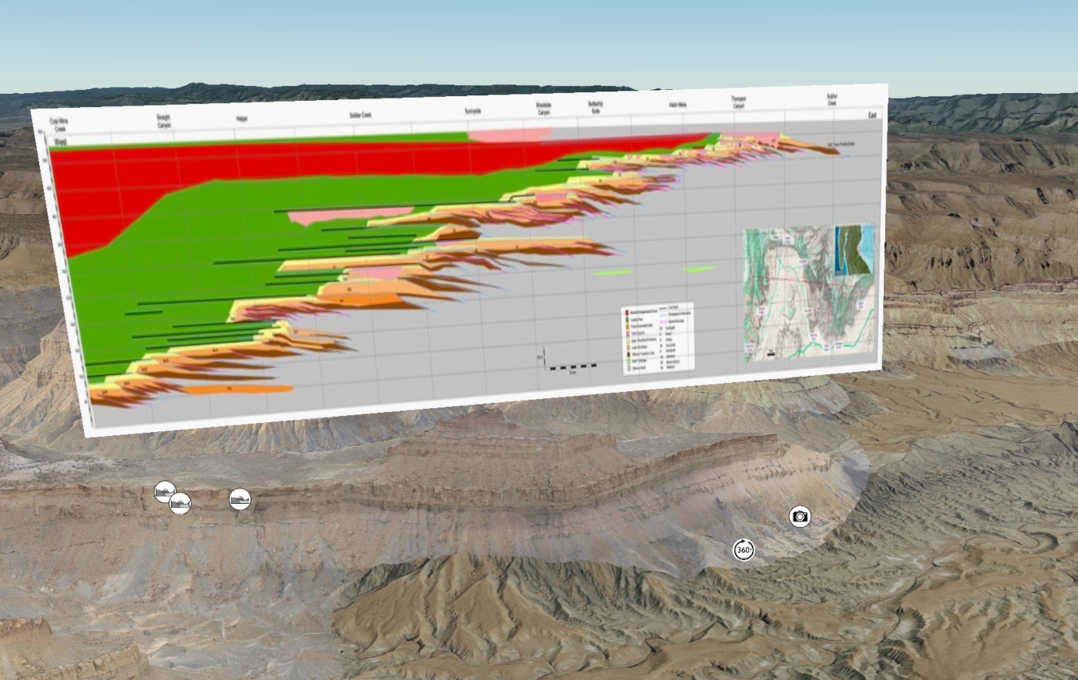
The Cretaceous Blackhawk Formation which crops out in the Book Cliffs of eastern Utah (USA) provides over 150 km of continuous exposures through a prograding clastic wedge. Since the 1980’s these outcrops have been central to the development of sequence stratigraphic and provide unparalleled insight into large scale geometries and architectures in shallow marine and coastal plain reservoirs such as the Brent Group, the Niger Delta and the Jurassic clastic deposits of the Caernarvon Basin.
Recent advances in digital outcrop acquisition techniques, including the use of drones to acquire photogrammetric 3D models has revolutionised reservoir analogue studies. In this presentation a dataset which includes over 100 km of virtual outcrop data will be used to provide a fully integrated Virtual Fieldtrip and highlight the use of this technology to provide quantitative analogue data, illustrate correlation strategies, provide input for reservoir models and illustrate links between modern and ancient systems. We will also discuss recent analysis of the perception of virtual field trips and demonstrate their pros and cons with respect to different audiences.