
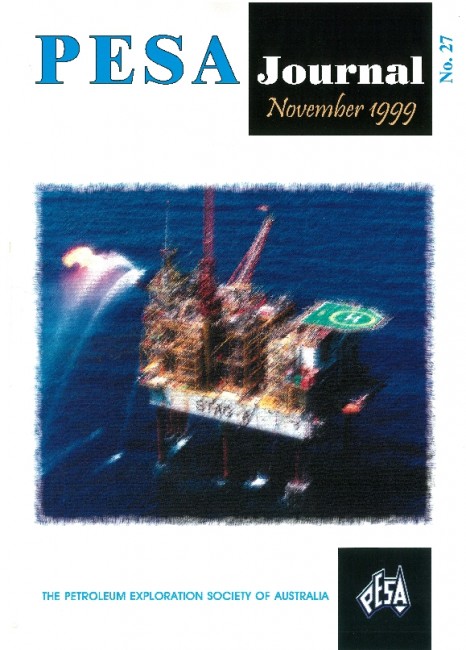

Publication Name: PESA Journal No.27
Authors: K.A. Webster
Publication Volume: 7
Date Published: November 1999
Number of Pages: 20
Reference Type: Journal Article
Abstract:
A record level of offshore exploration activity was achievedduring 1998, despite a significant fall in the oil price.
Seventy four offshore wells were drilled, far exceeding the
previous record of 64 wells achieved in 1990. Conversely,
only 94 onshore exploration wells were drilled during the
year, 25 fewer than in 1997, resulting in a slight reduction in
the total exploration wells drilled from 176 in 1997 to 168
in 1998, following what had been a steady increase since
1992. Seismic acquisition in 1998 was also at a record level,
twice that recorded in 1997. In contrast, the final quarter of
1998 may reflect the reduced activity forecast by industry,
with less exploration wells spudded and almost 10,000 line
km fewer than that shot during the 1997 December quarter.
This increased offshore exploration activity was rewarded
with several discoveries and appraisal successes. The
Carnarvon Basin was again the most successful area for
offshore exploration in 1998, with 35 wells spudded during
the year. The discoveries included Gipsy-1, Rose-l, Lee-1,
John Brookes-], Vincent- I, Caribou-1, Legendre South-1
and Mutineer-lB . In addition, significant successful
appraisal drilling included two Gorgon wells, Egret-2,
Dockrell-2 and Woollybutt-2A STl.
The Cooper/Eromanga Basin continued to be the focus of
onshore exploration in Australia. Fifty two exploration
wells were spudded during the year. Discoveries were
heavily weighted toward gas, with only one oil discovery in
the basin, Chilla-1 . The most significant gas discoveries
included Verona-1 and Cabernet-1.
Other important oil and gas discoveries and appraisal
successes occurred in the Bonaparte Basin, at Sunset
West-1, Sunrise-2 and Evans Shoal-2; in the Browse Basin,
at Caspar-lA and two of the Comea wells; in the Otway
Basin, at Killanoola-1/DWl; in the Bass Basin, at White
Ibis-1; in the Bowen Basin, at Yandina-2; and in the Surat
Basin, at Digger-1 and West Noorindoo-1. Three significant
appraisal wells were drilled in Papua New Guinea during
1998: Hides-4 proved continuity of the Hides field over a
distance of 12.6 km, Moran-4X extended the Moran field to
the northwest and Moran-5X constrained the southeastern extent of the field. There were also significant discoveries in
two New Zealand basins and these are covered in greater
detail in Plume (1999).
The lower oil price presents a challenge for the industry to
maintain these high levels of exploration activity. New
technology and better data quality have allowed
reinterpretation of previously uneconomic or subcommercial
discoveries to successfully confirm the
existence of economic fields . Several of the recent
commercial discoveries followed up uncommercial
discoveries drilled as much as 30 years earlier and have
highlighted the fact that potential still exists in these areas.
Improved subsurface imaging through 3D seismic
acquisition, high-resolution processing, pre-stack depth
migration and advanced time-to-depth conversion, together
with improved geological understanding, has contributed to
many of the successful wells drilled in 1998.