

- This event has passed.
PESA WA August Technical Evening: Two Talks – Back water effects on Fluvial reservoirs and Neoichnology of the De Grey ephemeral river delta
Hosted with thanks to our Platinum sponsor SLB:

Gold Sponsors IKON Science:

and Silver Sponsors Delft, Qeye, Totum Compliance, Core Laboratories and Task Fronterra Geoscience:





PESA WA invites you to our technical evening on Thursday 14th August.
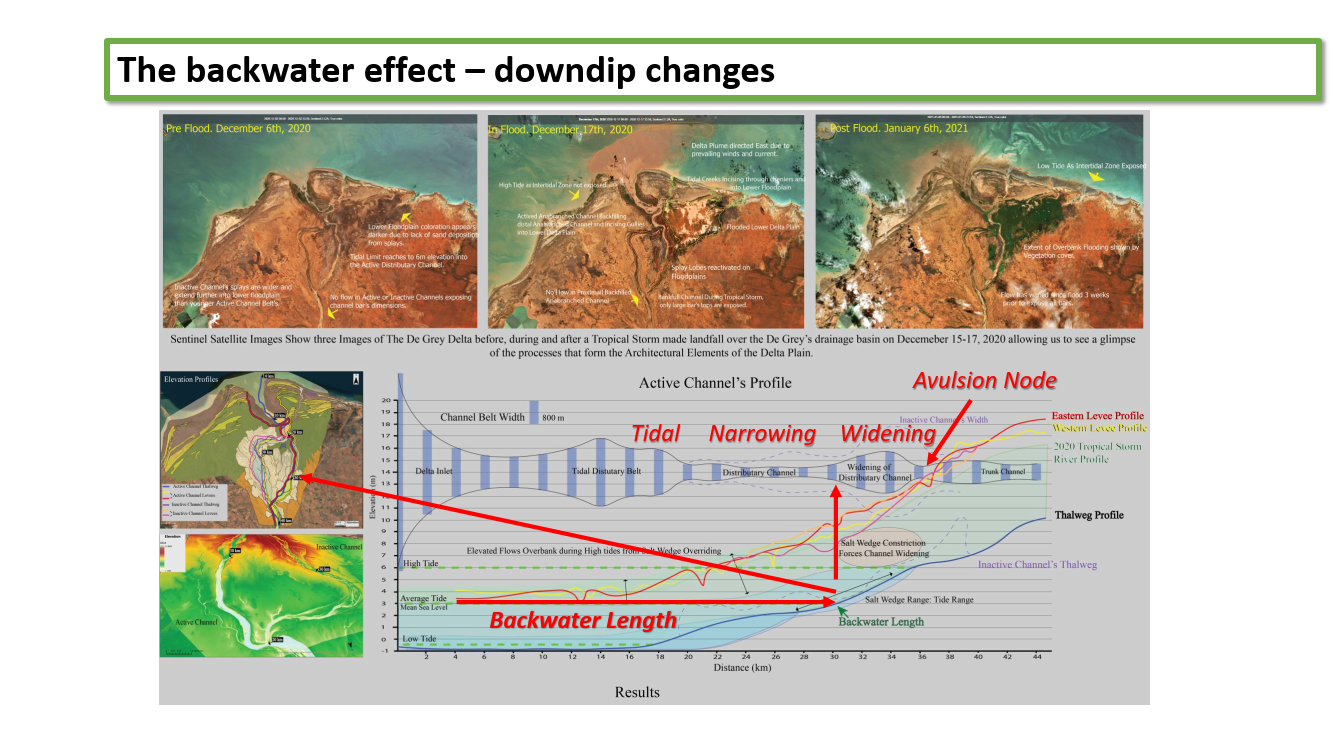
Quantifying the backwater effect on Fluvial reservoirs
Presented by John Holbrook (Dept. of Geological Sciences, Texas Christian University)
The backwater effect is an emerging tool for predicting reservoir volumes and heterogenicity in fluvial systems. It scales channel-belt width, tidal impact, and bar development to the channel size and the distance from the coast, two measurable parameters. The backwater effect (i.e. adjustments in open-channel flow as a response to proximity of standing water) is used to predict down-dip changes in morphodynamics and consequent sediment distribution on fluvial systems. However, there is currently no standardized method to obtain input parameters to estimate backwater length, nor where to measure these variables, for both modern and ancient settings. This study reviews existing methods for estimating backwater lengths in both settings and proposes workflows to minimize ambiguity in the results. The proposed workflows are prioritized based on practicality, accuracy, and smallest uncertainty ranges and allow different data types as input parameters. For the first time, applying multiple methods to obtain backwater length estimates is tested, both on a modern and ancient river system. In the modern case study, the riverbed intersection with sea level matches previously documented major changes in sedimentary trends. However, backwater lengths based on h/S (h = bankfull thalweg channel depth, S = slope) plot downstream of this zone which is characterized by major changes, when input parameters are derived from discharge and grain size. Therefore, we recommend obtaining bankfull thalweg channel depth from a cross-sectional profile if backwater length is estimated based on h/S. In the ancient case study, bankfull thalweg channel depth derived from fully preserved single-story channel fill and slope based on Shields’ empirical relation with grain size, match changes in fluvial architectural style interpreted as a result of backwater effects. This review is a critical step forward in discussing and acknowledging the uncertainties and ambiguity in obtaining the necessary input parameters to estimate and compare modern and stratigraphic backwater lengths. The proposed workflows facilitate comparability and applicability of future backwater length estimates and subsequent interpretations of the hydrodynamic environment and resulting stratigraphic record. Potential scaling relationships between the backwater length, sedimentary trends, and avulsion nodes make this of key importance as the latter two also play a crucial role in devastating floods when rivers change course.
Neoichnology of the De Grey Ephemeral River Delta, Northwest Coast, WA: Proxies for Environments, Physicochemical Conditions, and Climate in Deep Time
Presented by Steve Hasiotis (Dept. of Geology, The University of Kansas)
The neoichnology of the alluvial plain, delta plain, and proximal delta front settings of the dryland, ephemeral De Grey River and its wave-dominated delta clearly show diagnostic patterns of plant and animal traces (and diversity), lithofacies, soils, groundwater profiles, and salinities controlled by the climatic setting. The climate is hot arid (Köppen BWh), with annual rainfall falling between December and June of 311.5 mm (avg) but is subject to large variations because of erratic cyclones. The river typically flows only after seasonal rainfall events generated by tropical, monsoonal cyclones or winter storms. These highly variable events are also associated with significant storm-wave reworking of the proximal delta front and lower delta plain. This research is timely because Cyclone Zelia, strengthening to category 5 but making landfall as a category 4 at De Grey, will provide a glimpse into how a dryland river–delta system and its physicochemical characters are impacted by major storms.
Prior to Zelia, alluvial plain channels are mostly devoid of water and water holes have fresh (<0.5 ppt) to lower oligohaline (< 2 ppt) salinities; mole cricket traces are abundant along the margins of these waterbodies, with some vegetation along the margins and at various positions in the channels proper. The alluvial plain itself contains plant roots, termite and ant nests, goanna and smaller reptile and mammal burrows. The delta plain contains traces produced by terrestrial and marine fauna; plants and terrestrial fauna dominate overbank deposits, whereas marine invertebrate and vertebrate fauna dominate the distributary channels, varying from upper oligohaline (4–5 ppt) to hypersaline (50 ppt) in salinity. Supratidal areas contain mangroves and are dominated by a variety of crab, polychaete, and other vermiform animal burrow, which increase in diversity to the intertidal areas and have the highest salinities. Intertidal settings are dominated by tidal processes and bedforms with a variety of crab, clam, gastropod, polychaete, and vermiform animal burrows in hypersaline conditions.
This research is important because trace fossils and paleosols of ancient fluvial–deltaic deposits can help distinguish between these systems deposited under drylands (ephemeral) vs. seasonal (intermittent) vs tropical (perennial) climate settings based on modern analogs. For example. most often the trace fossil-lithofacies-pedofacies associations preserved in core are very useful to improve interpretations of the degree of lateral and vertical continuity of paleoenvironments – continental vs transitional vs marine – that are used to interpret reservoir geometry and continuity.
Ticket Prices:
Member: $35.00
Concession Member [Retired or Hardship]: $30.00
Graduate Member: $20.00
Student Member: $10.00
Non-Member: $50.00
Concession, Student and Graduate Member pricing ends Thursday (1 week prior) at 5pm (AWST).
Related Events
-
Tuesday, 20 October @ 5:30 pm - 7:30 pm (Australia/Perth time)
 WA
WA -
Thursday, 22 October @ 12:00 pm - 2:00 pm (Australia/Adelaide time)
SA/NT
-
Sunday, 25 October (Australia/Darwin time)
 WA
WA