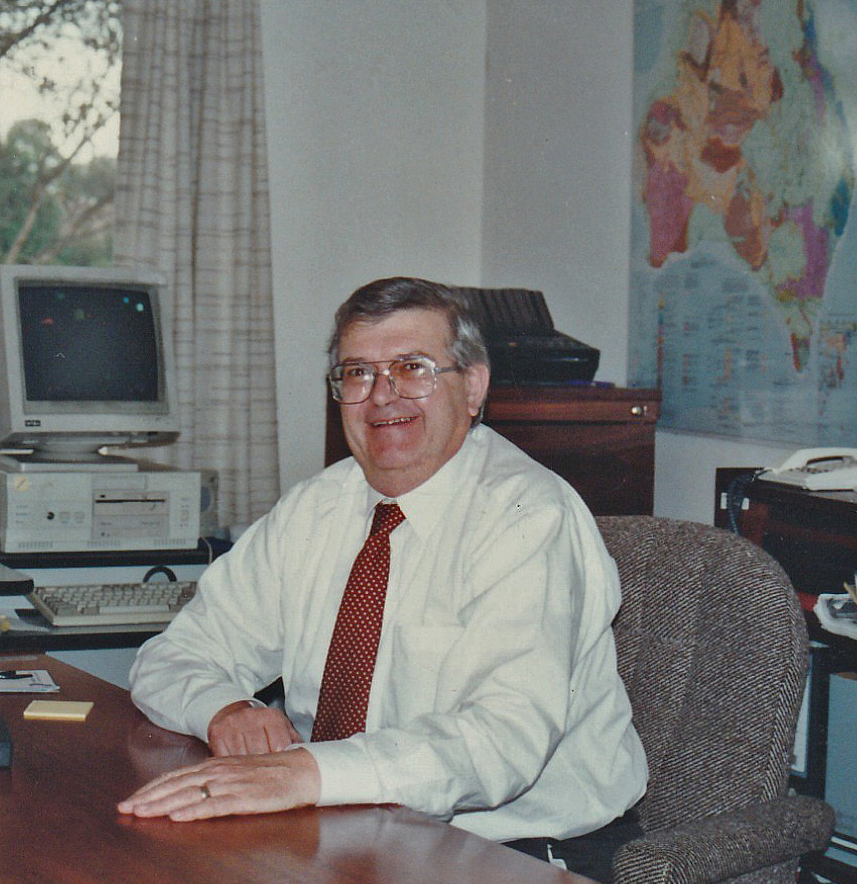
Dr John Scott was an internationally known and respected geologist, known
especially in Australia for his Curtin professorship and geochemical studies. His
career across half a century was wide-ranging, enlivened by the adventure of foreign
assignments and enriched by coincidences that brought new directions, lifelong
friends and a lifetime partner. He loved rocks, books and a glass or two of red wine,
not necessarily in that order, his daughter wrote recently, and all who knew him
would agree.
Born in England in August 1944, John attended primary and secondary school in
Essex and, on his father’s advice to spread his wings, studied geology at the
University of Wales (Aberystwyth), gaining a BSc in 1965 and an MSc and Diploma
in Micropalaeontology in 1966. In 1970 he was awarded a PhD from the University
of Reading for research on modern carbonates and associated microfauna off the
Atlantic coast of Ireland. Those research years in a caravan that served as both
home and laboratory, collecting samples with the help of local fishermen and relaxing
in the local pub bred a lasting affection for the Irish and their joy in company.
One of the formative experiences of his youth and a lifelong source of stories began
when he joined the Geology Department at the University College, London University
as a Research Fellow and worked on the Co-operative Investigation of the
Caribbean and Adjacent Region. CICAR was investigating the possible
environmental impacts of a proposed canal through Central America to link the
Caribbean and the Pacific. John was assigned to the Royal Navy with officer status
aboard HMS Fox, with three doctoral students to supervise. He had already
acquired a broad knowledge of WW2 and naval history, and this ensured he was
quickly accepted aboard. Lifelong friend, Peter Dolan one of those students, recalls
that John’s fulsome belly-laugh and fondness for institutional protocol (pass the port
to the left in the officer’s ward-room) also served him well. John enjoyed the
geopolitics of the Navy ‘showing the flag’, but he enjoyed even more the visits to the
small Caribbean islands where ‘well victualled receptions’ were held at the residence
of the UK’s colonial representative.
When those balmy days at sea ended, however, John found himself back with his
students in ‘the Caribbean hut’, a grotty WW2 annex at UCL and his enthusiasm for
this adventure waned. In 1971 he joined Abu Dhabi Petroleum Company (ADPC), a
subsidiary of the Iraq Petroleum Company (IPC), initially as a wellsite geologist and
then working on Cretaceous carbonate reservoirs offshore. In 1974 he was promoted
to Exploration Geologist, responsible for co-ordinating geological aspects of the
exploration programmes.
One of John’s life’s blessed coincidences came at Christmas 1972 when he met an
Australian nurse from WA, newly arrived that day to work in the ADPC medical clinic.
They recognized kindred spirits, were an item by New Year and married in England a
few months later. In 1977 Wendy returned to England to give birth to their first child,
then travelled with babe in arms by ferry and car to Tunisia to join John who had
commenced worked there earlier that year with Buttes Gas and Oil. ‘We were
young’, Wendy says now, looking back with some amazement. ‘In those days, you
just did it’.
They returned to England in 1979 and settled near Reading, eventually purchasing a
5-acre farm, where they ran Gloustershire Old Spots pigs, chickens and geese. Two
other children soon joined the menagerie and added to the barely controlled chaos.
Encouraged by Peter Dolan, John formed a small consultancy, Petroleum Geological
Analysis Ltd, and began work on several small oilfields in the Great Oolite reservoir
in Southern England. The company also began a series of multi-client exploration
studies that were to become its highly respected trademark, with initial projects
detailing the basins onshore UK and in the North Sea.
In the early 1980s, another of John’s serendipitous moments occurred, when he was
contacted by Reading University and asked for advice on handling the hundreds of
thousands of samples – cores, cuttings, outcrop samples and thin sections – they
had been given from IPC’s Middle East operations from the 1920s to 1961. John
recognized the need to minimize the ‘destruction’ of samples while extracting the
enormous amount of exploration data on offer: a major multi-client study was the
answer. He assembled an experienced consulting team and their report, Petroleum
Geology of the Middle East, was completed in 1985, to wide acclaim and major
sales, providing substantial income for the university and the companies. It was this
study which shifted John’s main interest from carbonates to the source rock studies
that were to dominate his later career.
As fate would have it, at the peak of their success, with a staff of about 10 in the
Reading office, PGA was overrun by the oil price crash of 1986. Grenville Lunn, one
of the senior staff, assumed he was heading for the exit until John announced he
was going to Australia and handed him the PGA reins. John had learnt of a vacancy
at Curtin University in Perth WA and successfully applied for the position of
Professor of Petroleum Geology and Director of the Key Centre in Resource
Exploration. The family moved to Perth and settled on a small farm at the base of
Gooseberry Hill in the Darling Ranges. A fourth child arrived in due course and farm
life in WA proved as chaotic and challenging as it had in the UK.
At Curtin, his students found him a breath of fresh air and enjoyed the enthusiasm he
injected into lectures and field trips. His industry experience, quiet manner and
intellect made him an exceptional teacher and he inspired many students to pursue
careers in the petroleum industry, Michelle Blake, Jack Buswell, Adam Craig, Rick
Deboer and Kieran Wulff among them. He is remembered fondly by his students,
who found in him an exceptionally generous mentor, always making time to listen
and offer thoughtful guidance.
At home, his children were lulled to sleep by his reading them Wordsworth’s
memories of daffodils or driven to delighted and chaotic bedtime terror by his reading
Lewis Carroll’s ‘The Hunting of the Snark’. They got their own back, they say, by
insisting on his repeated readings of He-Man and Captain Pugwash stories so often
he could recite them.
John’s entrepreneurial spirit soon led him to establish PGA Consultants Pty Ltd in
Perth as a ‘sister’ company to the UK consultancy. In co-operation with Curtin and
Dolan and Associates, he conducted multiclient studies of the Perth Basin and the
North West Shelf. Then, not long before he resigned from Curtin, John met Birgitta
Hartung-Kagi over a glass of wine (naturally) at the Curtin staff club and learnt of her
newly-formed Geotechnical Services Pty Ltd. They collaborated for over 15 years on
many multiclient projects, dealing mainly with source rock assessments and oil-
source rock correlations in Australian and Middle East basins. Their long and
successful association sponsored a close friendship, with John even conceding
eventually that there was such a thing as German humour. He also had input
through the 1990s on PGA UK studies on the petroleum geology of Iraq and Syria
basins.
In 1995 John formed Black Rock Resources Australia NL (Black Rock) to explore for
what he called ‘self-sourcing reservoirs’ (SSR). Horizontal drilling had opened the
Bakken Shale play in the USA’s Williston Basin a few years earlier and John saw the
Canning Basin’s Goldwyer Formation, with its G. prisca source shales as a direct
analogue. The key would be finding fracture zones from which the oil could be
released by deviated wells. He acquired an interest in EP 373 covering a large area
of the Barbwire Terrace, where Western Mining’s Acacia and other 1980s wells had
identified both conventional plays and Goldwyer SSR potential. Black Rock identified
a drilling target and negotiated heritage clearance in the early 2000s but was
ultimately unable to attract interest and the project faded. Black Rock also explored
several licences onshore UK, but drilling was unsuccessful.
In the early 2000s John worked with Sphere and Baraka on projects in Mali and with
P&R/Petronas in a major study on Ethiopia’s Ogaden Basin. His consultancy work
slowed down progressively as the Australian industry declined. He resigned from
PGA in 2014.
John began to suffer from dementia in his seventies and had been in care for some
years. His room was full of books and pictures of his family and naval vessels whose
history he knew so well. He suffered a stroke in early November and died quietly a
few weeks later. His family plan a private ceremony and will scatter John’s ashes at
sea.
Peter Purcell
(with much help from John’s family and friends)
Related Articles

15/08/2024